Physical Address
Indirizzo: Via Mario Greco 60, Buttigliera Alta, 10090, Torino, Italy
Physical Address
Indirizzo: Via Mario Greco 60, Buttigliera Alta, 10090, Torino, Italy

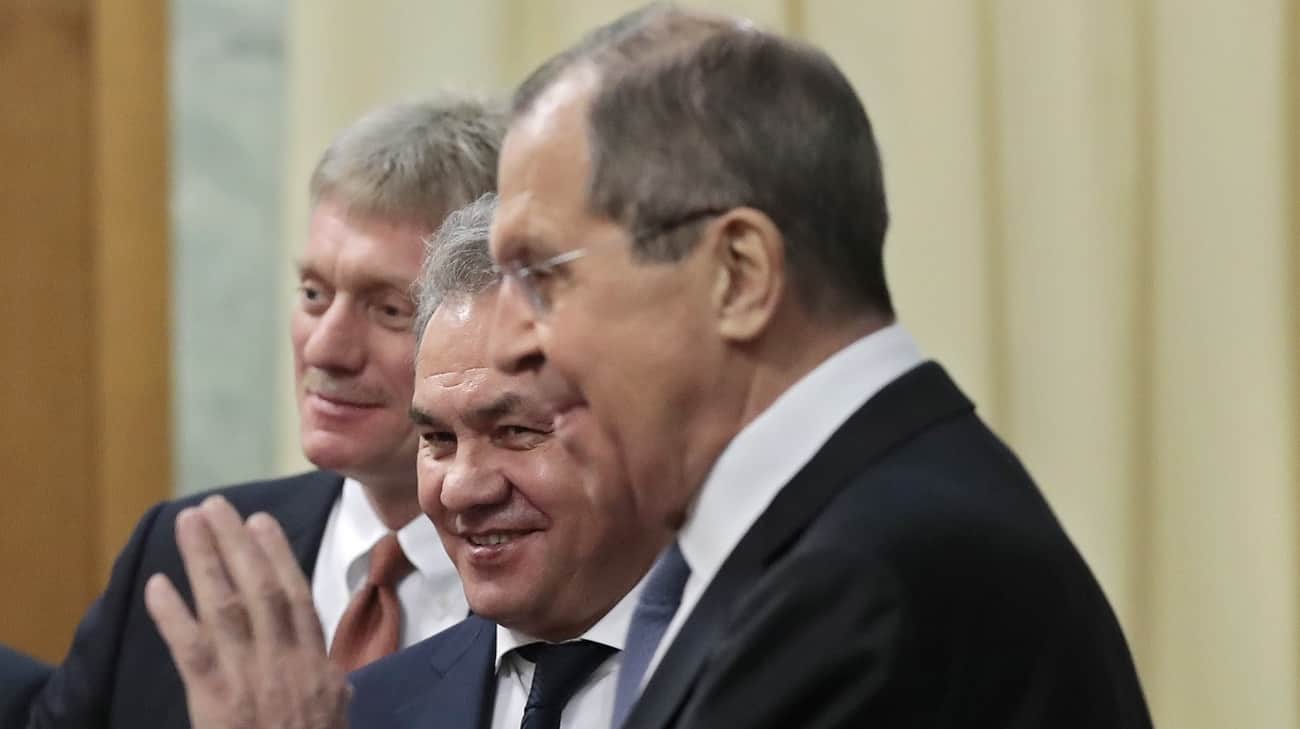
Dmitry Peskov, Sergei Shoigu and Sergei Lavrov, Photo: Getty Images
Kremlin spokesman Dmitry Peskov, Russian Defence Minister Sergei Shoigu and Russian Foreign Minister Sergei Lavrov have stepped up information operations to push Ukraine to negotiate and make the West fear the Kremlin and take a position of self-deterrence.
Source: Institute for the Study of War (ISW)
Details: Military analysts have noted Shoigu’s attempts to threaten France in order to deter support for Ukraine. Shoigu feigns interest in peace talks. This is part of a broader Russian information operation aimed at persuading Western countries to push Ukraine into unequal negotiations on Russia’s terms.
Advertisement:
The Kremlin has used this general information operation about escalation with NATO to target France specifically, following French President Emmanuel Macron’s calls for the West to increase the level and type of security assistance it sends to Ukraine.
Peskov said that NATO and Russia are in “direct confrontation”. Thus, the Russians are intensifying their current information operations to force the West into self-deterrence.
On 4 April, Peskov said that relations between Russia and NATO have “slipped to the level of direct confrontation” and that NATO is “already involved in the conflict surrounding Ukraine.”
Peskov accused NATO of moving closer to Russia’s borders, likely referring to the recent accession of Finland and Sweden to the alliance, and said that NATO was expanding its military infrastructure closer to Russia.
Military analysts have noted that Russian officials have long sought to portray NATO and the West as an existential threat to Russia in order to justify the Kremlin’s war in Ukraine. For example, on 18 March, Russian President Vladimir Putin said that a full-scale war between NATO and Russia was undesirable but possible.
Peskov’s repeated statements that NATO and Russia are already in a “direct confrontation” are a reinforcement of this narrative but are likely still part of Russia’s reflexive control campaign, which uses threatening language to delay and influence important decisions about Western support for Ukraine. This Kremlin narrative is also likely an attempt to portray NATO’s defensive activities in response to Russia’s outright aggression as provocative.
Lavrov also promoted information operations, simulating interest in negotiations. Lavrov used a meeting of dozens of foreign ambassadors from non-Western countries to condemn Ukraine’s “peace formula” while claiming that Russia was ready to negotiate on terms favourable to the Kremlin.
The ISW notes that Russia is continuing to prepare for a potential war with NATO forces. The Russians are carrying out military reforms, recreating the Leningrad Military District and the Moscow Military District in the country’s west. Russian officials have accused NATO of giving Russia a pretext to re-establish the district directly on the border with Finland.
To quote the ISW’s Key Takeaways on 4 April:
Support UP or become our patron!