Physical Address
Indirizzo: Via Mario Greco 60, Buttigliera Alta, 10090, Torino, Italy
Physical Address
Indirizzo: Via Mario Greco 60, Buttigliera Alta, 10090, Torino, Italy

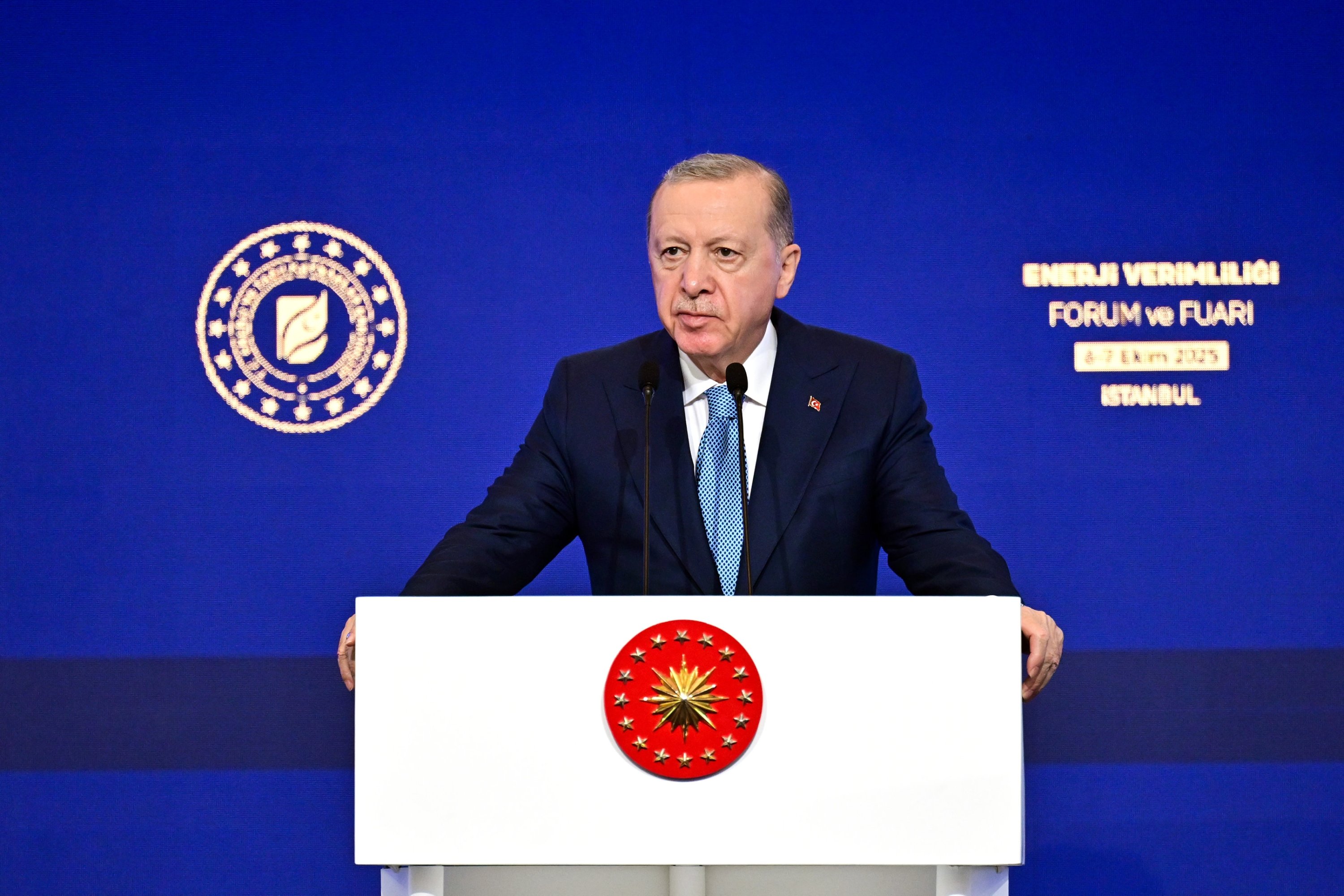
President Recep Tayyip Erdoğan on Monday emphasized the strategic importance of energy security, warning that reliance on a single country or source poses significant risks, as he outlined Türkiye’s efforts to diversify its energy mix and expand renewables, reiterating the long-term goal of achieving self-sufficiency.
Türkiye, which has been importing over 90% of its energy needs, has been pushing to cut its import bill and boost supply security by developing domestic resources, investing in renewables and expanding international partnerships in oil and gas exploration.
Speaking at the 11th Energy Efficiency Forum and Fair, Erdoğan said the world is entering an era where energy and supply security have become “among the most strategic issues for humanity,” with rising populations and expanding economies driving global demand ever higher.
“Developing countries are striving to grow faster than the world average,” he noted. “When it comes to energy supply, demand and security, humanity faces a future full of challenges.”
The president also pointed to what he described as deep “energy injustice” visible from space. “Satellite photos showing different continents reveal the stark contrast between the illuminated north and the dark south,” he said. “Unless the global energy paradigm changes, achieving a fairer and more balanced picture will remain difficult.”
Erdoğan noted that Türkiye’s growing population and expanding economy have pushed up energy consumption in tandem with prosperity. “The rise in energy demand signals not only growth and population increase but also higher welfare,” he said, adding that electricity has become “a necessity rather than a luxury.”
Citing domestic data, he said sales of household appliances exceeded 10 million units last year, a 7% rise from 2023, while electric vehicle sales surged to 134,000 units in the first nine months of 2025.
“A life without electricity is now unthinkable, not only in cities but even in the remotest villages,” he said.
Natural gas consumption has also grown rapidly. “In 2002, only five cities in Türkiye had gas infrastructure. Today, all 81 provinces have access,” Erdoğan said. “The share of our population with access to natural gas has risen from 33% to 85%.”
Türkiye’s economy, he added, has maintained strong momentum since 2002, with average annual growth of 5.4% between 2003 and 2024. The country’s GDP reached the $1 trillion mark for the first time last year, and per capita income has climbed from $3,600 to over $15,000 in two decades, approaching $17,000 on an annualized basis as of the second quarter of this year.
“Our goal is to expand the economy to $1.9 trillion and lift per capita income to $21,000 by 2028,” Erdoğan said, citing targets of the government’s newly announced medium-term program.
Türkiye’s population is expected to exceed 88 million by 2030 and reach 94 million by 2050, according to the president, up from nearly 86 million as of the first half of this year.
“We all know very well what this means in terms of energy demand and consumption,” Erdoğan said.
Also addressing the event, Energy and Natural Resources Minister Alparslan Bayraktar said Türkiye’s electricity demand will likely triple over the next three decades as the country’s economy and population expand.
“Over the past 23 years, our electricity demand has tripled, and it will increase threefold again over the next 30 years,” Bayraktar said.
Erdoğan said Türkiye’s biggest challenge remains its dependence on imported fossil fuels. “We are not a country with abundant oil or gas reserves,” he said. “Most of the fossil fuels used in daily life and industry must be imported.”
Türkiye’s annual natural gas consumption rose from 17.4 billion cubic meters in 2002 to 53.2 bcm in 2024 and is forecast to reach nearly 60 bcm this year.
“We paid $26 billion for energy imports in just the first eight months of 2025,” said Erdoğan.
To cut this bill, he highlighted the 785 bcm natural gas reserve Türkiye discovered five years ago in the Black Sea, the largest in the country’s history. Gas from the Sakarya field has been flowing to shore through the Filyos processing plant since last year. “We now meet the needs of 4 million households from there. This will rise to 8 million in 2026 and 16 million by 2028.”
On oil, Erdoğan said Türkiye now produces around 160,000 barrels per day domestically, compared with the total demand of 1 million barrels.
“With discoveries in Gabar and the Black Sea, we’ve made serious progress,” he said, noting that Türkiye now ranks fifth globally in exploration capacity with four drilling and two seismic vessels.
It is due to become fourth in the world as it has purchased two new drillships, of which the first arrived last week.
Erdoğan stressed that diversification remains key to the security of supply. “Being dependent on a single country, source, or route for energy procurement carries significant risks,” he said.
“Just like in all other fields, we will keep pushing forward tirelessly and relentlessly in energy as well, until we reach our goal of a fully independent Türkiye,” he added.
He recalled that during the early months of the Russia-Ukraine war, Türkiye weathered the crisis “comfortably” thanks to the TurkStream pipeline and its diversified import network, while Europe experienced hardships.
“We faced no problems in industry or households,” he said.
“This is undoubtedly due to the policies we have implemented over the past 23 years to provide our country with affordable, high-quality and uninterrupted energy. We have carried out strategic initiatives in energy production within Türkiye and launched projects one by one to transform our country into an international energy hub and corridor,” he added.
Erdoğan went on to stress Türkiye’s efforts to diversify its suppliers, especially in energy categories where it was dependent on foreign sources.
“In 2003, we sourced natural gas from only five countries. Today, BOTAŞ trades with 34 countries, both importing and exporting gas,” he said.
This year, Türkiye began receiving natural gas from Turkmenistan for the first time, reaching 465 million cubic meters since March.
On nuclear energy, Erdoğan said Türkiye aims to enter a “higher league.”
Türkiye plans to build three conventional nuclear power plants. The first one, Akkuyu, is being built by the Russian conglomerate Rosatom in the southern province of Mersin.
The plant will deliver its first electricity “very soon,” Erdoğan said. The $20 billion, 4.8 gigawatt (GW) four-reactor Akkuyu will bring Türkiye into the small club of nations with civil nuclear energy. The plant is the third-largest nuclear pipeline globally, according to Global Energy Monitor (GEM). Once fully operational, it is expected to generate around 10% of Türkiye’s electricity.
Türkiye plans to build the second and third plants in the northern Sinop and Thrace regions. On Friday, Energy and Natural Resources Minister Alparslan Bayraktar said they may work with the United States and South Korea for the second plant and that this may be in the form of a trilateral model.
Ankara earlier said it was also in talks with Russia, China and Canada for the facilities.
Erdoğan said he had discussed the matter with his counterparts during his recent trips to China and the U.S., where he met with President Donald Trump and oversaw the signing of a deal on civil nuclear partnership.
“The memorandum of understanding signed with the U.S. on strategic civil nuclear cooperation is a milestone,” he said. “It covers advanced reactor technologies and small modular reactors.”
Officials say Türkiye still needs at least eight additional reactors, as well as 5 GW of small modular reactors, to enhance energy security and ensure an affordable electricity supply. The country aims to reach 7.2 GW of nuclear capacity by 2035 and 20 GW by 2050.
Türkiye, which imported $65 billion worth of energy last year, must make the most of its domestic resources, Erdoğan said. “Energy efficiency alone can bring annual savings of $5 billion,” he noted.
Minister Bayraktar said energy efficiency is not merely a matter of saving money but a driver of industrial competitiveness and sustainable growth.
“Energy efficiency reduces our industrialists’ costs and increases their competitiveness,” he said. “This enables us to produce more value with fewer resources, thereby contributing to our success.”
Bayraktar noted that Türkiye’s demand for energy, particularly electricity, is also increasing every year.
Highlighting the global trend, Bayraktar noted that investments in energy efficiency have risen by 50% in the past five years to reach $650 billion.
He said Türkiye has made “historic progress” over the past two decades, enacting the country’s first Energy Efficiency Law and implementing wide-ranging plans, projects, and regulations across sectors, from buildings and transport to industry and agriculture.
Erdoğan went on to stress that Türkiye’s transition to clean energy remains a government priority. The Climate Law adopted in July was an important move toward the 2053 net-zero emissions target, he added.
According to Erdoğan, Türkiye has become one of the leading countries investing in green energy in recent years.
“The share of renewable energy in our total installed capacity has surpassed 60% as of this year,” he added.
Erdoğan said they aim to crown this achievement by hosting the COP31 climate summit in 2026.