Physical Address
Indirizzo: Via Mario Greco 60, Buttigliera Alta, 10090, Torino, Italy
Physical Address
Indirizzo: Via Mario Greco 60, Buttigliera Alta, 10090, Torino, Italy

Few places in the world show how powerfully music can unite former foes quite like the Balkans.
Inevitably, I have to return to a standard phrase, “What are the borders of the Balkans?” or “Where do the Balkans begin and end?”
In the storyline that I want to share here, I would limit it closely to the borders of the former Yugoslavia (so somewhere between Slovenia and North Macedonia).
There is much to be said of this region. Also known as the Western Balkans, it is often seen as one of the most complex regions in Europe, even beyond. Open history books or pages of major newspapers in any of these countries nowadays, and you would still mostly come across some sort of struggle, divisions, conflict, underdevelopment and so on. But what I’d like to talk about today is something else: music.
Music, perhaps, stands as one of the few remaining, yet flimsy bonds that truly link countries like Bosnia-Herzegovina, Serbia, Montenegro, Croatia, North Macedonia and others in the region. And never is this better seen than in cases when truly legendary music artists, who millions of people admire, pass away.
The death of one such musician, a singer, recently, captivated and saddened millions of souls across the region, but also in parts of Europe, the U.S. and even as far as Australia.
Just a couple of days ago, Bosnian-born legendary folk singer Halid Beslic passed away at the age of 71, after being hospitalized for some time due to severe illness.
His close fellows, other singers, some of whom he was in touch with for decades, influencers, journalists, sportspeople and ordinary citizens were equally devastated, sharing dozens of personal stories and messages commemorating the life of Beslic. Even Bosnia-Herzegovina’s often-divided politicians were seemingly united in tribute.
And not only in Bosnia-Herzegovina. On Sunday, gatherings in the name of Beslic were held in numerous cities worldwide, starting from the Bosnian capital Sarajevo, where at least 20,000 people are estimated to have come together, to metropolises and regional centers like Paris, Vienna, Munich, Sydney, Istanbul, Zagreb, Belgrade and dozens of others.
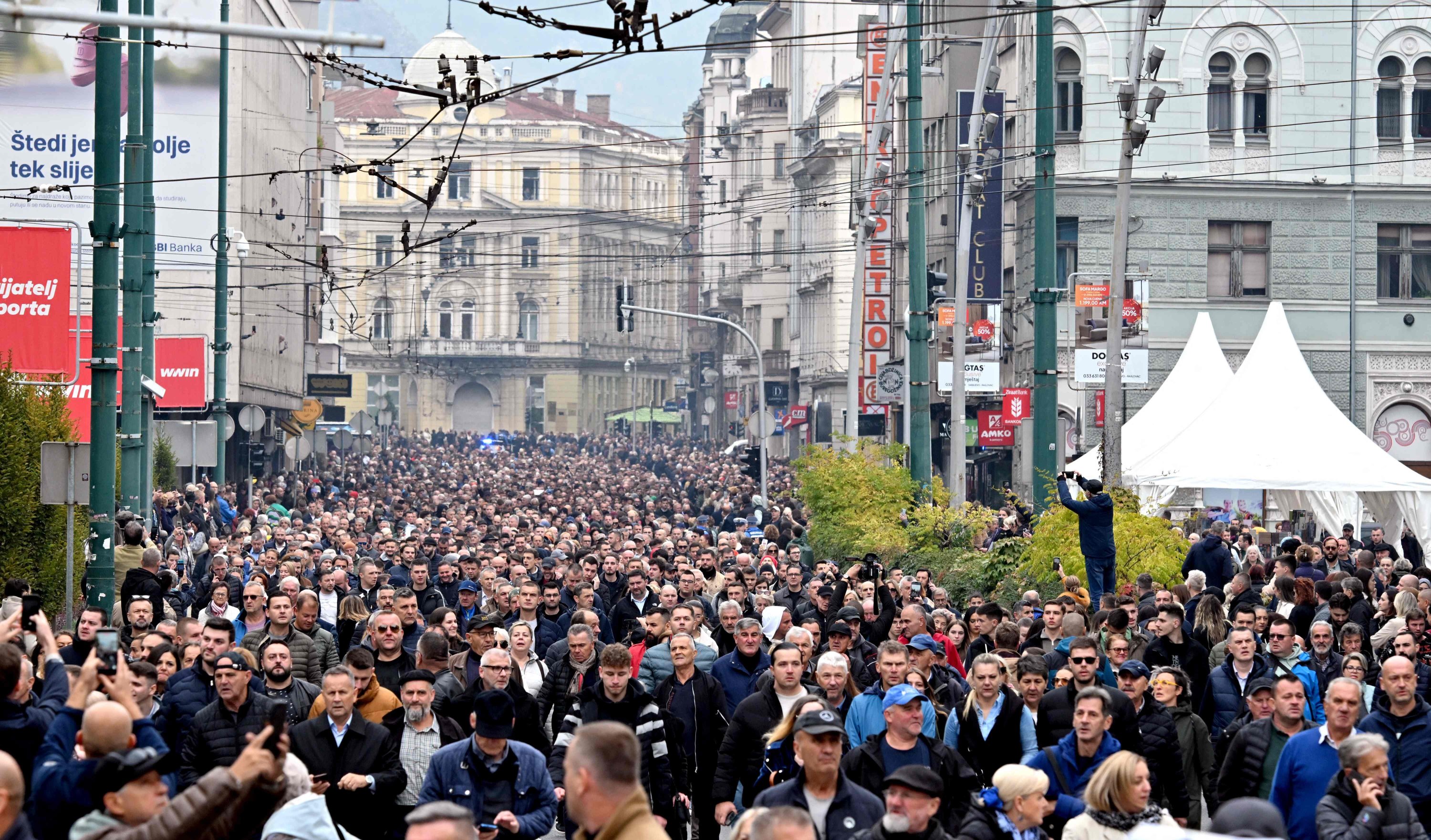

Also rarely seen, politicians across the political spectrum were among those personally paying tribute to the legendary singer in the matter of hours of news on his death. Yet, the death of this icon, whose songs are somehow calibrated into common memory and identities of people, firstly in Bosnia-Herzegovina, but then also of some in Serbia, Croatia and Montenegro and along with which generations have celebrated weddings, birthdays, spent nights in clubs, held family gatherings, has once again brought to the surface the fragility of Bosnia-Herzegovina’s political system.
Following the sad news, widespread media coverage, countless Facebook statuses and shared images clearly indicated that the loss of the famous singer meant much more than a loss for one group or the music world and that it transcended individuals’ affection for Halid.
It clearly demonstrated that this loss was a loss of all, a loss of one nation, often divided but here yet again united in pain and sadness. It also may be reflected that one of the names, with his unique spirit, love and shared respect for others (as seen through his extensive humanitarian work) – which also partly belonged to one past time – was now gone and was also taking with him all of that.
Born in 1953 in the village of Knezina, close to Sarajevo, Beslic rose to prominence in the early 1980s, the decade often recognized for the ex-Yugoslav rock scene, but also the era that produced much in cinematography and music in general, so that it could be easily described as one of the most successful creative periods for this region.
All of this said, it is incomprehensible that Council of Ministers of Bosnia-Herzegovina did not even include on its agenda the proposal to observe a day of mourning in the whole of the country to commemorate the life of the artist whose career spanned decades, whose songs were borrowed for cult movies and who was ever-present on domestic scene, enriching the culture enormously and leaving a legacy that is no way can be neglected.
Still, this did not reflect the real picture of what was in the people’s hearts. Many gathered, cried, but also sang together songs like “Prvi Poljubac” (“First Kiss”), “Mijacka” and “U Meni Jesen Je” (“Autumn Inside Me”).
For those unfamiliar, Bosnia-Herzegovina was split into two entities following the Dayton Peace Agreement that ended the bloodshed of the war in ’90s. Today, 30 years later, it remains widely divided as nationalist tensions and fears persist, and it is not a member of either NATO or the European Union.
Thus, decisions are often complex, delivered late, or in cases obstructed due to the lack of consensus or will among political actors. This was again witnessed in the case of Beslic’s death, unfortunately.
However, despite the politics, the debate on what makes Beslic so unique, or trying to comprehend how this large crowd of people from across the region, regardless of their religious or national backgrounds, admired and loved him so much, feels simple and difficult at the same time.
It’s maybe because he was such a heartfelt, open, endlessly cheerful person, who did not want to dig deep down complicated issues and topics that divide, but was rather living for his music, performance, smile and good talk. It is also maybe because he was such a great artist. Or both.
I still remember, when a couple of years back, Serbian balladeer Djordje Balasevic, sadly, passed away. Another famous Bosnian singer, Dino Merlin, cried in a short video while singing a passage from one of his songs. These days, not only Merlin, dozens of other artists cried and mourned Beslic. Without exaggerating, the magnitude of pure, raw emotion was probably immeasurable.
Maybe that’s what music does best – it reminds everyone of feeling, of what, deep down, still binds everyone together.
I recently read a great article about Beslic, penned by Bosnian-Croatian writer Miljenko Jergovic in 2009, just after he had a car accident at the time.
“He is some good soundtrack for a land of car wrecks, destroyed houses from which trees grow, mined fields and mountains, lost hope and permanently separated tribes, great European and world metaphors, and the deepest and most scary South Slavic province, the Bosnia that no longer exists and the Bosnia that went nowhere, the country with the most extensive diaspora on the globe. Halid Beslic is the voice of an entire scattered world, and this is not easy to understand from the perspective of the first neighborhood, as well as from Bosnia itself,” he wrote.
Indeed, Beslic is just that, a symbol of Bosnia, with all its scars, good and bad, its past, its soul, its music. And maybe even more than that. Time will tell.