Physical Address
Indirizzo: Via Mario Greco 60, Buttigliera Alta, 10090, Torino, Italy
Physical Address
Indirizzo: Via Mario Greco 60, Buttigliera Alta, 10090, Torino, Italy

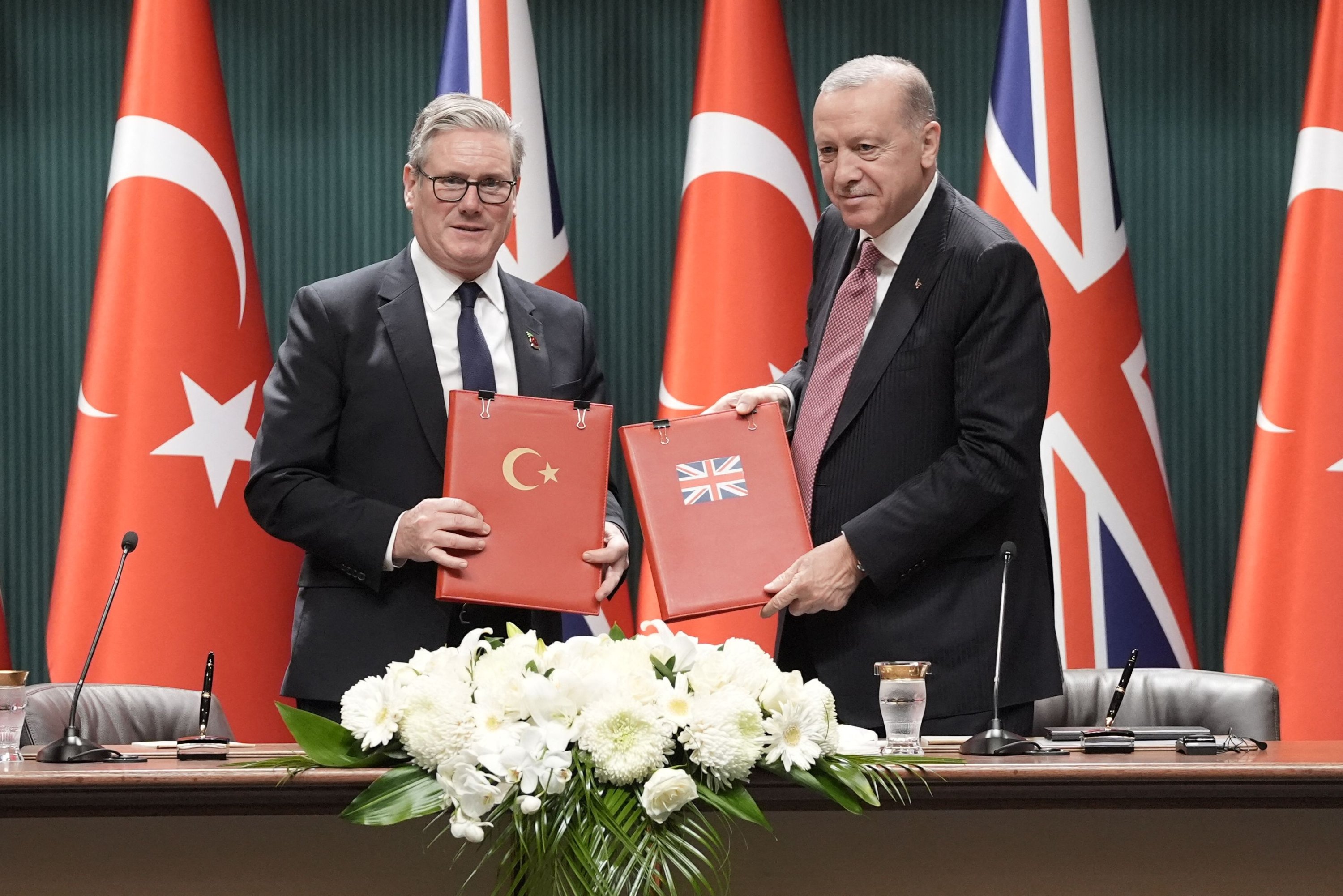
Türkiye and Britain on Monday signed a multibillion-dollar agreement for Eurofighter Typhoon fighter jets and Ankara said it was also seeking more warplanes from Gulf states.
The deal deepens the NATO allies’ ties and bolsters the defense air defenses of Türkiye, which is seeking to leverage the advanced jets to make up ground with regional rivals such as Israel, which has unleashed strikes across the Middle East this year.
Europe, meanwhile, has increasingly turned to Türkiye, NATO’s second-largest military and a major exporter of armed drones, to reinforce its eastern flank and potentially backstop any future post-war stabilization force in Ukraine.
President Recep Tayyip Erdoğan hailed the Eurofighter deal, signed in Ankara during British Prime Minister Keir Starmer’s first visit to the country, as “a new symbol of the strategic relationship between us as two close allies.”
He thanked the other members of the four-nation consortium that builds the jets: Germany, Italy and Spain. The consortium is represented by BAE Systems, Airbus and Leonardo. Erdoğan is due to host German Chancellor Friedrich Merz on Thursday.
Starmer called the deal a “landmark moment” and described it as “a win for British workers, a win for our defense industry, and a win for NATO security.”
The agreement is worth 8 billion pounds ($10.7 billion) and covers 20 Eurofighter jets that Türkiye will buy from the United Kingdom.
It marks the first new order of U.K. Typhoons since 2017 and the “biggest fighter jet deal in a generation,” Britain’s Defense Ministry said.
London said Ankara would receive the first of the batch of Typhoons in 2030. Starmer said the deal, for which talks began in 2023, provides the option for the sale of more jets in the future.
As part of Starmer’s visit, three Eurofighters of the Royal Air Force had also arrived in Türkiye. It was not immediately clear whether the jets would be handed over to Türkiye or would be used for the training of Turkish pilots.
Erdoğan said joint defense industry projects could follow.
Türkiye and the U.K. signed a preliminary deal in July for the Eurofighters. The deal followed Germany’s reported decision to lift its longstanding opposition to the sale of the jets to Türkiye.
Last week, Erdoğan toured three Gulf nations and held talks on the potential acquisition of used Typhoons from Qatar and Oman.
In addition to the 20 new Typhoons from the U.K., Türkiye plans to purchase 12 secondhand jets from Qatar and 12 others from Oman, Defense Minister Yaşar Güler said.
The jets from Qatar could potentially arrive early next year, Güler told reporters.
Despite boasting NATO’s second-largest army, Türkiye often faced arms embargoes in the past. That pushed it to significantly boost domestic capabilities and curb foreign dependence over the last two decades.
Today, it produces a wide range of vehicles and arms types domestically, including its own drones, missiles and naval vessels. It’s also developing its own fifth-generation fighter jet.
Named KAAN, the stealth fighter is sought to replace the Air Force Command’s aging F-16 fleet, which is planned to be phased out starting in the 2030s.
Enjoying its warmest ties with the West in years, Türkiye has sought to procure the Eurofighters and also potentially U.S.-made F-35s to backstop its fleet.
It views the purchase of Typhoons and other advanced jets as an interim solution until KAAN becomes operational. That is expected by 2028.
Türkiye also seeks reentry into the U.S.-led F-35 fighter jet program. It was excluded in 2019, and Washington imposed Countering America’s Adversaries Through Sanctions Act (CAATSA) sanctions due to its purchase of Russian-made S-400 missile defense systems.
Last year, Türkiye secured a $7 billion deal with Washington for 40 F-16s. But talks have reportedly been dogged by Turkish concerns about the price and desire to buy F-35s instead.
Erdoğan raised the issue of the sale of F-35s during a recent meeting with U.S. President Donald Trump at the White House.
Ankara is reportedly considering proposing a plan that could have included a U.S. presidential “waiver” to overcome the CAATSA sanctions and pave the way for an eventual resolution of the S-400 issue and F-35 purchase.
Türkiye and the U.S. have publicly stated a desire to overcome this, saying the allies have the political will to do so.
Ankara aims to capitalize on the two leaders’ good personal ties and Erdoğan’s help in sealing Trump’s Gaza cease-fire agreement to eventually reach a deal.
Turkish officials have said Türkiye wants to acquire a total of 120 fighter jets – 40 Eurofighters, 40 U.S.-made F-16s and 40 F-35s – as a transitional fleet ahead of the KAAN’s entry into service.
On Monday, Starmer visited the Turkish Aerospace Industries’ (TAI) facility in Ankara, where he received a briefing on KAAN.
Air attacks by Israel on Türkiye’s neighbors Iran and Syria, as well as on Lebanon and Qatar, have unnerved Ankara over the past year and persuaded it to revamp its defenses, officials said.
Erdoğan has sharply criticized Israel’s relentless attacks on Gaza and elsewhere in the Middle East.
Starmer praised Türkiye’s role in facilitating the Gaza cease-fire and noted that the U.K. and Türkiye are working together to implement the agreement “as fast as possible to put the region on a better path.”
Erdoğan commended Britain’s recent decision to recognize the Palestinian state, calling it a bold step toward a two-state solution.
“It is our collective responsibility to uphold the Gaza cease-fire; the Israeli government must be restrained,” he stressed.
Greece, a largely symbolic but sensitive threat to Türkiye, is expected to receive a batch of advanced F-35s in the next three years.
In years past, jets from the two NATO states often conflicted during patrol flights above the Aegean Sea and occasionally had dogfights, and Greece has previously expressed concerns about Turkish military buildup.
Jet upgrades are part of a broader effort to strengthen layered air defenses that also includes Türkiye’s domestic “Steel Dome” project and an expansion of long-range missile coverage.
Europe has sought closer relations with Türkiye as it scrambles to ramp up its defense amid fears fuelled by the war in Ukraine that Russia may attack an EU member in the coming years, and calls by U.S. President Donald Trump for Europe to do more for its own security.
The continent and NATO members have also been alarmed by recent mysterious drone flights over the airspace of European Union member countries.
Starmer said the Eurofighter deal represented a boost for NATO security, telling broadcasters in Türkiye: “Having that capability locked in with the United Kingdom is really important for NATO.”
“Our countries may sit at either end of Europe, but we’re strong partners, working more closely together now than ever before,” he said during a signing ceremony alongside Erdoğan.
“This will bolster security across NATO, deepen our bilateral defense cooperation and boost economic growth here and in the United Kingdom, securing 20,000 British jobs,” Starmer added. “I am proud that British typhoons will form a vital part of the Turkish Air Force for many years to come.”
Britain’s Defense Ministry said the deal would strengthen Türkiye’s combat capabilities and bolster “NATO’s strength in a key region.”
British Defense Minister John Healey, who traveled to Ankara with Starmer, said the deal “goes far beyond” aircraft.
“It is the leading edge of the growing defense and industrial partnership between our two nations,” he said, calling Türkiye “an important NATO ally and the gatekeeper to the Black Sea.”
Intrusions into NATO’s airspace, some of them blamed on Russia, reached an unprecedented scale last month. Some European officials described the incidents as Moscow testing NATO’s response, which raised questions about how prepared the alliance is against Russia.
Since the first incursions of Russian drones into Poland in early September, northern European NATO member states have registered at least another 38 incidents spanning Scandinavia, Belgium and the Baltic states, according to the Washington-based Center for European Policy Analysis.
Russia has repeatedly denied links to these incidents.
The intrusion into Poland forced NATO aircraft to scramble to intercept Russian drones and shoot down some of the devices. It was the first direct encounter between NATO and Moscow since Russia launched its all-out war on Ukraine on Feb. 24, 2022.
Days later, NATO jets escorted three Russian warplanes out of Estonia’s airspace.
Since then, flyovers have occurred near airports, military installations and critical infrastructure, among other locations, elsewhere on the continent and prompted European defense ministers to agree to develop a “drone wall” along their borders to better detect, track and intercept drones violating Europe’s airspace.
Many European nations have announced plans for major increases in defense spending. The EU itself, driven by fears of a Russian attack and doubts about U.S. security commitments, has approved creating a 150 billion euro ($176 billion) EU arms fund to boost the defense industry, labeled the SAFE scheme.
The scheme allows for agreements with non-EU countries, like Norway, Britain or Türkiye, who have defense equipment the EU is interested in.