Physical Address
Indirizzo: Via Mario Greco 60, Buttigliera Alta, 10090, Torino, Italy
Physical Address
Indirizzo: Via Mario Greco 60, Buttigliera Alta, 10090, Torino, Italy
After six years of meticulous work, the world’s largest handwritten Quran has been completed in Istanbul. Measuring 4 meters (13 feet) in length and 1.5 meters in width per page, the manuscript is a record-breaking achievement in Islamic calligraphy.
Ali Zaman, born in 1971 in the Raniye district of Sulaymaniyah, Iraq, initially made his living as a jeweler while developing a passion for calligraphy from an early age. He began practicing the art in middle school and in 2013 decided to leave jewelry behind to devote himself entirely to calligraphy.
In May 2017, Zaman moved with his family to the Fatih district of Istanbul to further pursue his artistic ambitions. Before relocating, he had completed a 30-page Quran project, with each page containing one part (juz’) of the scripture, measuring 210 by 150 centimeters. That project took three years and was completed in 2019.
Zaman then embarked on an even more ambitious undertaking. He spent a year researching, determining measurements and sourcing materials. In mid-2020, he presented the design to his teacher, Bijar Erbili, and received approval to begin the world’s largest handwritten Quran project.
The manuscript’s pages, which expand to 3 meters when opened, were written entirely with traditional reed-and-scroll pens in the thuluth script. Zaman avoided using any modern tools throughout the process.
For six years, he worked daily in a small room located in the courtyard of Istanbul’s Mihrimah Sultan Mosque in Fatih. His day began after morning prayers and continued with only brief breaks for meals and worship. He often spent hours perfecting a single letter, carefully transcribing every verse line by line.
Zaman’s health began to decline in late 2019, and by October 2023, he had to pause his work due to illness, losing weight from 83 kilograms to 58 (183 to 128 pounds). Despite these challenges, he completed the project without any external support.
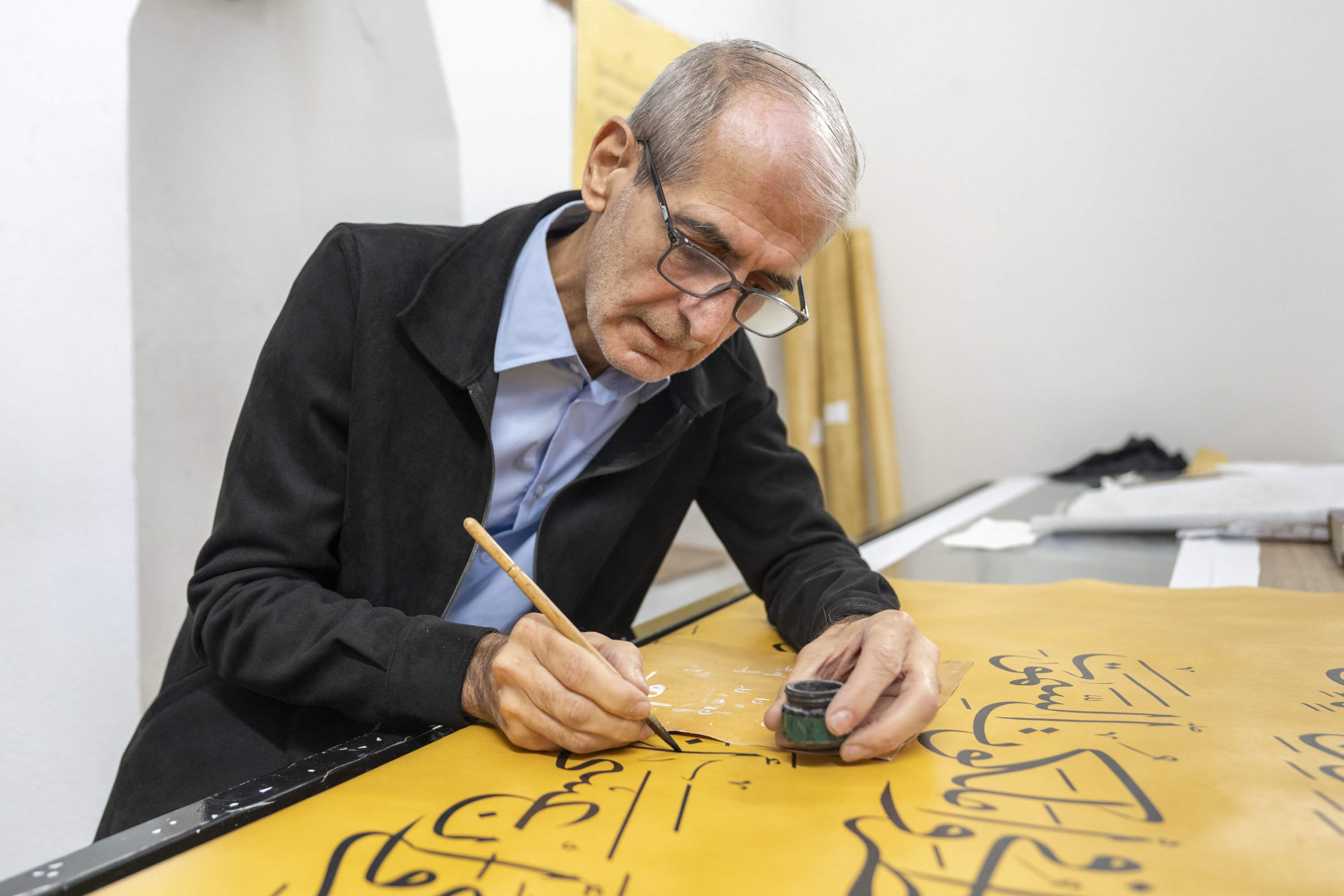
Internationally recognized, Zaman has won first prizes in the thuluth and naskh categories at competitions held in Syria in 2007, Malaysia in 2014, Iraq in 2015 and Türkiye in 2019. In 2020, he received an ijazah (official authorization) from prominent calligraphy teachers, including Ahmet Abdurrahman Erbili, Bijar Kerim Erbili and Sabah Erbili. In 2017, he also received the “prestige” award at the International Hilye-i Sherif Competition in Türkiye, presented by President Recep Tayyip Erdoğan.
Zaman said that once he picked up the reed, he felt inseparable from his art. “Everything comes from the soul, and the work you create is very important,” he said. “Being able to create something that few can do or few would attempt gives me happiness and pride.”
His son, Rekar Zaman, said his father was born into an ordinary family and moved to Türkiye in 2017 to develop his calligraphy further, as the art is more widely recognized there. At that time, Zaman had completed the 30-page Quran project. Later, he decided to create the world’s largest handwritten Quran.
“He wanted to create something unique. The idea of writing the world’s largest Quran came to him, but in Iraq, he had neither the space nor the recognition to pursue it. After moving to Türkiye, he believed it would gain greater value and began the work,” Rekar Zaman said.
The project officially began in 2019. The family studied the measurements of the existing largest Quran in the world, which measures 2.28 meters in length and 1.55 meters in width. Zaman’s manuscript is 4 meters long and 1.5 meters wide, reaching 3 meters when opened. “My father worked alone for six years on this, and the result is outstanding,” Rekar Zaman said.
Visitors to the room where the manuscript was created are often amazed. “For example, a teacher from a madrassa was astonished, saying ‘Mashallah’ with wide eyes. Students also admired it and congratulated my father,” Rekar Zaman added.
The family plans to protect the manuscript from fire or tearing and will make it available for display or study, although its permanent location, whether in Türkiye or abroad, has not yet been decided.
Zaman emphasized the importance of keeping the work in Türkiye. “During the Ottoman period, calligraphy was highly valued. While the Quran itself is precious, calligraphy is especially significant in Türkiye. We hope it remains here, adding to the country’s cultural archives,” he said.