Physical Address
Indirizzo: Via Mario Greco 60, Buttigliera Alta, 10090, Torino, Italy
Physical Address
Indirizzo: Via Mario Greco 60, Buttigliera Alta, 10090, Torino, Italy

On Oct. 29, 1961, the nation prepared to celebrate the Republic Day with a new era in Turkish industrialization. As military parades marched through Ankara, President Cemal Gürsel prepared to showcase a symbol of independence: a car built in Eskişehir, by Turkish engineers, in record time. The vehicle had an equally defiant name: Devrim – “Revolution.”
The story began earlier that year inside the Eskişehir Railway Factories, the workshops better known for producing locomotives than luxury. Gürsel aimed to accelerate industrialization in 1960 as he issued a direct order: to build a car, from scratch, using Turkish products, Turkish minds and Turkish hands.
The assignment landed on the desks of about 30 engineers at the Turkish State Railways (TCDD). They were given just 129 days. The project quickly became more than an engineering challenge; it was a national test. Skeptics in the press and the bureaucracy downplayed the event and muttered, “They can’t do it.” The team, spurred by doubt, embraced the task as a matter of honor.
The mechanics and engineers lived in the workshop as they worked meticulously day and night, while they sketched, welded and tested to achieve their goal. It was as if they were racing against time to deliver within the given date.
By late October, against all odds, four prototypes were ready. Each bore a playful nickname from the workshop floor: Siyah (Black), Beyaz (White), Mavi Boncuk (Blue Bead), and Gecekondu (Shanty). Together, they represented both the sophistication and the improvisation that defined the project.
The cars shared a modest but modern design: a 1,250-kilogram body, top speeds of 140 kilometers per hour, headlights that could be switched by foot, and a steering column with an adjustable mechanism, a feature that Cadillac would later surprisingly adapt within a two-year span. Except for the glass and tires, every part of the car was made domestically.
On Republic Day, two of the cars were sent by train to Ankara: one black and one beige. The train journey had forced a strange regulation. Because of railway safety rules, the cars’ tanks had been emptied to a minimal amount of fuel.
That morning, amongst the cheering crowd and press, Gürsel stepped into the sleek black car outside Parliament, and all eyes were on him. Cameras rolled, the car roared, then faltered. Just a few hundred meters into the drive, the engine stopped. The black Devrim had run out of fuel.
Quickly ushered into the beige Devrim, the president continued his ride to Anıtkabir without incident. However, the damage had been done, and the public perception via the press was ruthless. The next day’s headlines distilled the moment into a single line: “Devrim stopped on the road.”
The press mockery overshadowed the magnitude of the achievement. The fact that a team of engineers, accustomed to building locomotives, had created a working automobile in just over four months was in itself an extraordinary success.
Yet in Ankara’s corridors of power, enthusiasm waned. Mass production never materialized. Four cars had been built, but no factory line was ever approved. Some blamed limited state resources. Others whispered about pressure from foreign manufacturers who were keen to keep Türkiye as a consumer and a market and not as a producer and a competitor. The project was halted altogether. What might have been the birth of a Turkish automobile industry was quietly shelved and stopped.
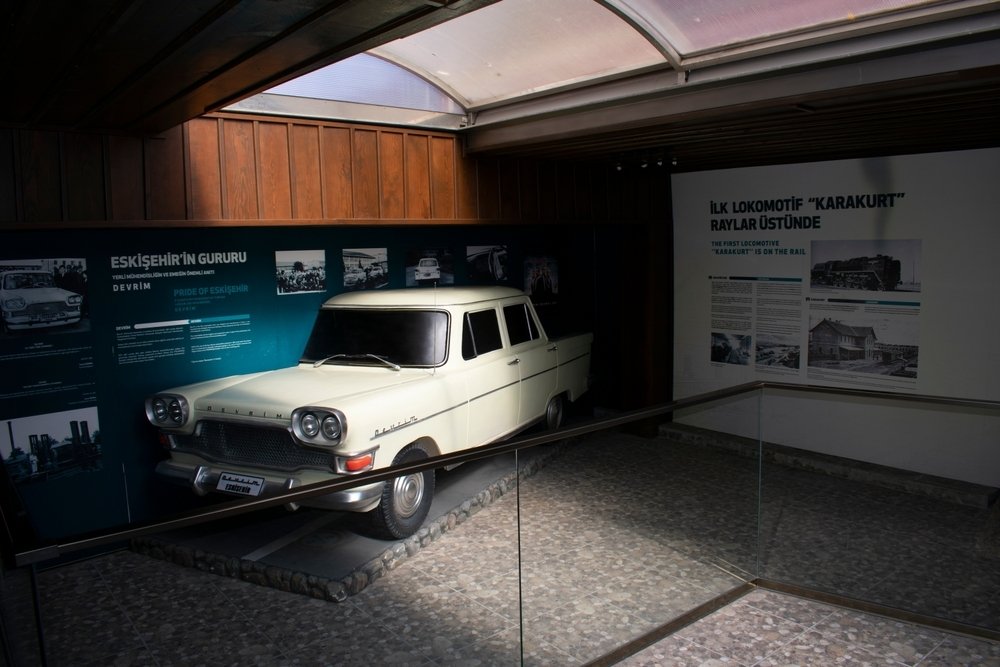
Today, one surviving Devrim – chassis number 0002 – is displayed at Turkish Railway Vehicles Industries Inc. (TÜRASAŞ) in Eskişehir. It stands as a relic of ambition, protected behind ropes, its fuel tank empty and its battery removed for safety. Visitors peer at its cream-colored body, read the plaque, and wonder what might have been.
At the museum, visitors can also see the welding machine, drill and lathe used in the car’s construction, along with the camera that documented its production stages, as well as calipers, compasses, rulers and the original drafting table. A limestone model of the car, spare parts, an original engine block cast for the railways in Sivas, and archival photographs of the work are also on display.
To those who were there, the car’s meaning was never just mechanical. It was about the will to show what could be done, despite the difficult circumstances and all the preventive measures.
The Devrim still resonates in Türkiye’s collective memory. For some, it is a story of betrayal, proof that domestic innovation can be sabotaged by external pressure. For others, it is a bittersweet reminder of what determination can achieve even with scarce resources.
And for today’s carmakers in Türkiye – from global giants manufacturing in Bursa to the nation’s newest electric car initiatives – the Devrim is a guide and proof of a chance at success. It represents a chance to seize the moment and endure as a symbol of possibility.
The Devrim project was never just about building a car. It was about proving that a country, only decades into its republic, could stand shoulder to shoulder with industrialized nations.
More than 60 years later, with Türkiye once again seeking to establish itself as a car-producing nation, the spirit of those engineers in Eskişehir lives on. Their creation may have been sidelined, but the pride it inspired still fuels dreams of innovation today.
The views and opinions expressed in this article are solely those of the author. They do not necessarily reflect the editorial stance, values or position of Daily Sabah. The newspaper provides space for diverse perspectives as part of its commitment to open and informed public discussion.