Physical Address
Indirizzo: Via Mario Greco 60, Buttigliera Alta, 10090, Torino, Italy
Physical Address
Indirizzo: Via Mario Greco 60, Buttigliera Alta, 10090, Torino, Italy
Major events in history ultimately lead to significant political, social and cultural changes in society and state life. Indeed, the great destruction wrought by World War I brought not only border changes but also major political transformations to Europe. The defeated empires and the dynasties that had ruled them for centuries began to withdraw from the stage of history.
As the war ended in 1918, the Ottoman Empire did not undergo a regime crisis, like many other empires, such as the Austro-Hungarian Empire. Governed by a constitutional monarchy, the empire still had a member of the Ottoman dynasty as its head, while political power rested with the ruling party. At the end of the war, the ruling party, the Committee of Union and Progress, resigned from the government and its leaders left the country. A new government was then formed and the armistice agreement was signed under these circumstances.
Unlike in Europe, in the Ottoman Empire, there was no atmosphere of opposition to the dynasty that had ruled the country for centuries, no rebellion in the defeated army, no insubordination, or any breakdown in the chain of command. The agenda in Ottoman Türkiye was to find ways and means to liberate the homeland from occupation as soon as possible.
Patriots organized resistance against the occupation with surprising energy, as if they had not just emerged from a world war. The nation took action to save itself, which was in dire straits. At this point, it must be emphasized that no one was concerned with regional solutions for liberation; instead, everyone was focused on saving the state and the homeland as a whole. This is a highly significant reflection of the Turkish nation’s understanding of homeland and state.
During the occupation of Istanbul, the relocation of the Parliament to Ankara marked the beginning of a new chapter in Turkish history. During this period, the new Parliament, the Grand National Assembly of Türkiye (TBMM), both strengthened its political authority and led the War of Independence to a successful conclusion. The political change and transformation that Europe experienced in 1918 did not take place in Türkiye immediately after World War I, but rather after the War of Independence (1919-1923).
After the victory, Parliament abolished the sultanate and deposed the sultan. He chose to leave the country without causing any internal unrest. Parliament then negotiated the Treaty of Lausanne with the Allied Powers for about six to seven months and signed it, thus crowning its military victory with a peace treaty. Following the withdrawal of the occupying forces from Istanbul in October 1923, Ankara took steps to clarify the country’s political regime. Following an amendment to the Constitution, the Turkish state was declared a republic on Oct. 29, 1923. On the same day, Mustafa Kemal Pasha, who was the president of Parliament and commander-in-chief, was elected as the first president of the republic by the assembly.
Although the republic was founded on principles opposing personal rule, Mustafa Kemal Pasha’s strong and charismatic leadership meant that the early years of the Republic of Türkiye were characterized more by consolidation than by full democratization. The transition toward a more democratic system would not occur until the 1950s.
Following that, military coups occurring roughly every 10 years hindered the deepening of democracy in Türkiye. Following the 1960 coup, military tutelage became institutionalized. Civilian authority was characterized by the notion that it “could hold power but could not be empowered.” The republic, founded on the principle of equal citizenship, gave rise to political, social, cultural and economic elites. It failed to adequately address major issues related to equal opportunity, development, freedoms, welfare and social justice. This was mainly attributed to the inability to reflect the national will in governance fully.
Discussions on adopting a presidential system began in the 1980s. During their presidencies, Turgut Özal and Süleyman Demirel both advocated for a transition to a presidential system to ensure more effective governance. This significant political transformation in the republic’s history became possible through the referendum held on April 16, 2017, which led to the transition to a presidential government system.
On Oct. 29, 1923, the framework was established for the head of state to be elected solely within the Parliament and from among its members. The 2007 referendum allowed for the president to be elected directly by the people, and on Aug. 10, 2014, Recep Tayyip Erdoğan was elected president for the first time by popular vote. On April 24, 2018, during the parliamentary elections, Erdoğan became the first president under the presidential system.
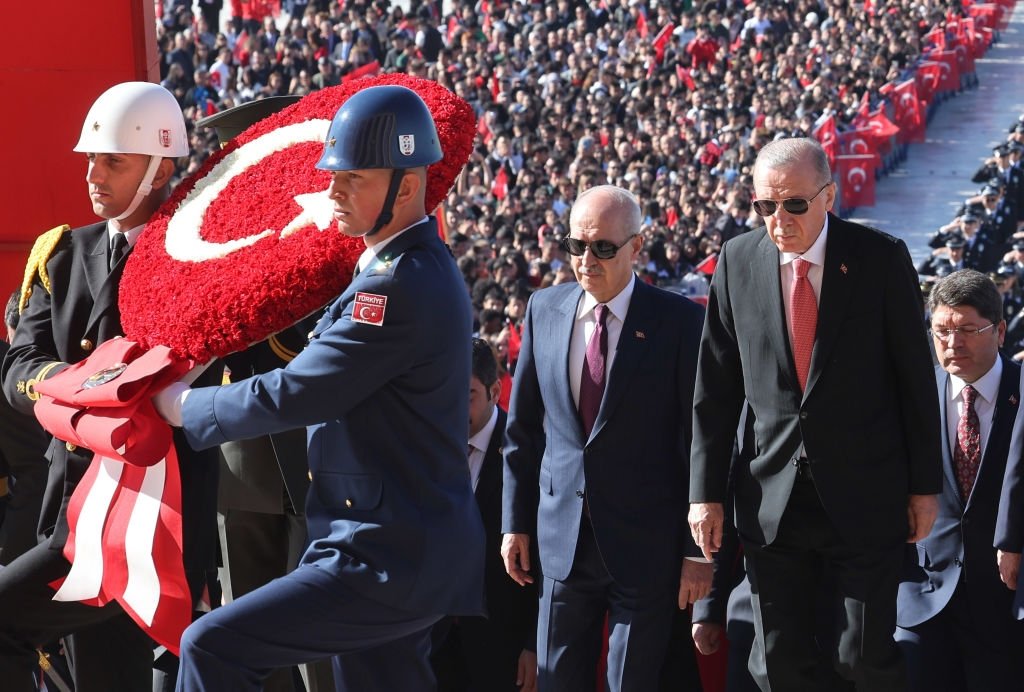
Throughout the century, the republic witnessed three constitutions and 13 coups and coup attempts. However, it has resolved political and administrative challenges, strengthened democratic standards, fostered prosperity and security within the country and the region. It has reduced regional disparities, established a balance between agriculture and industry as well as rural and urban areas, ensured that distribution is as fair as production, and continued to serve as the voice of humanity’s conscience. Moreover, Türkiye is rapidly advancing toward becoming a country that is technologically innovative, economically self-sufficient, and a creator of value on the global stage.
Türkiye’s political and economic stability secures its role as a regional power. Yet this power does not threaten anyone; instead, the country is transforming its extensive state experience into opportunities for the region and the world. Türkiye continues to prevent wars, resolve conflicts, provide aid to the oppressed and welcome refugees. All political, military, diplomatic and bureaucratic personnel of the Republic of Türkiye operate with an “ultra-humanitarian state” approach, actively applying Mustafa Kemal Atatürk’s principle of “peace at home, peace in the world” to promote peace throughout the region and beyond.
The views and opinions expressed in this article are solely those of the author. They do not necessarily reflect the editorial stance, values or position of Daily Sabah. The newspaper provides space for diverse perspectives as part of its commitment to open and informed public discussion.