Physical Address
Indirizzo: Via Mario Greco 60, Buttigliera Alta, 10090, Torino, Italy
Physical Address
Indirizzo: Via Mario Greco 60, Buttigliera Alta, 10090, Torino, Italy

Iraqis will head to the polls on Nov. 11 to elect a 329-seat Parliament from among 7768 candidates. For the first time in years, the country enters an election in relative calm, with reduced regional and domestic violence giving political blocs space to focus on internal issues rather than security crises.
Beneath this calm lies a system unchanged in its fundamentals. Iraq remains governed by informal power-sharing among Shiite, Sunni and Kurdish communities. At the ballot box, they fragment into competing parties, but when voting ends, they reconverge to negotiate governance roles. The arrangement is ritualized: a Shiite prime minister, a Sunni parliamentary speaker and a Kurdish president. Elections determine how offices are allocated among factions more than who governs.
In 2019, during the Tishreen protests, Iraq’s youth rebelled against sectarian rule and corruption, crying, “We want a homeland.” Since then, it has become clear that street protests can shake the system, but only the ballot can change it. Yet this hope is undermined by a system that benefits from low voter turnout. Only 70% of adults possess biometric voter cards, leaving 9 million disenfranchised. If Sadrists, Generation Z voters and disillusioned Sunnis stay home, turnout could collapse into the 30% range.
Meanwhile, Iraq’s demographic reality compounds political stagnation. More than 60% of Iraqis are under 30. Youth unemployment exceeds 25% and poverty nears 30% in some provinces. The major factions offer no credible programs for this generation. The calm before this election is an intermission, not stability.
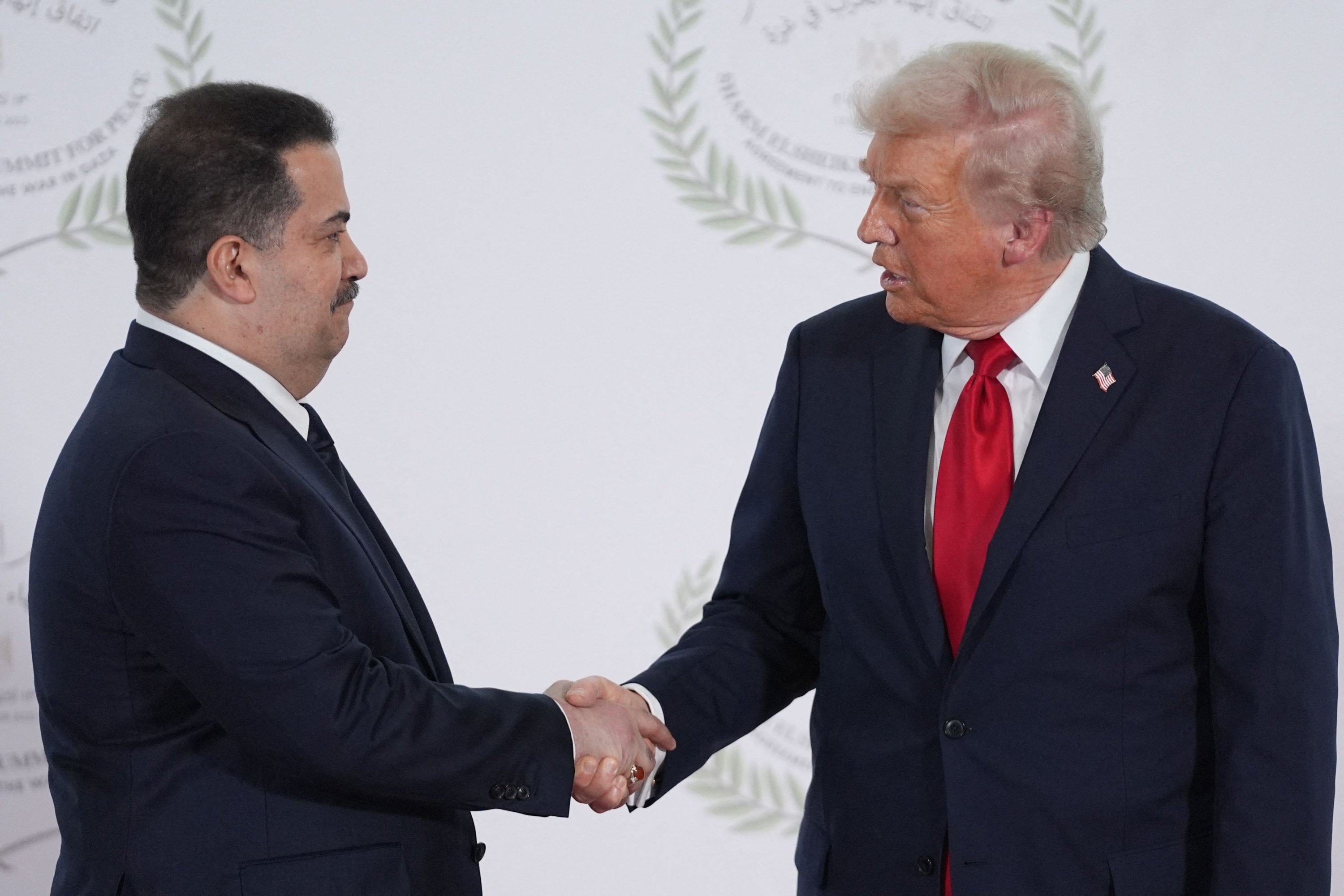
Within this fractured system, Prime Minister Mohammed S. Al Sudani has rebranded the state as a “services government,” focusing on roads, electricity, schools and infrastructure. He has positioned himself as a balancer between Washington and Tehran, between Shiite factions and between Arabs and Kurds. He avoided escalation during Gaza operations and Israel-Iran wars even as Iraqi skies were repeatedly violated. His nationalist messaging is deliberately non-sectarian, earning goodwill among Sunnis.
He signed major energy deals, infrastructure projects, a three-year budget, and personal intervention in stalled files. But there are also drawbacks. He has expanded the state payroll by around one million jobs and widened subsidies to unsustainable levels. Without new and stable revenues, Iraq risks a fiscal cliff. Sudani may be approaching the moment where he must choose between popularity and reform.
If his coalition wins 50-60 seats, he enters post-election negotiations with a strategic advantage. A nod from Shiite cleric Muqtada al-Sadr could transform that into a landslide victory. Yet Sudani must still engage with Iran-aligned factions, the Najaf clergy, and diverse Sunni and Kurdish blocs. His power is real but conditional, not sovereign.
Despite holding no official position, al-Sadr is one of Iraq’s most influential figures. In 2021, he won the largest bloc in Parliament. When negotiations failed, he withdrew, taking millions of voters with him. Al-Sadr’s exit left a massive vacuum, affecting turnout and providing the Iran-aligned Coordination Framework freedom to maneuver.
Strategically, he has repositioned himself, speaking against sectarianism, supporting regime change in Syria and reacting cautiously to Gaza. These are signals for Washington, Riyadh and Abu Dhabi. He sees a regional order emerging after Iran’s shattered Shiite crescent. However, he carries a contradiction: he calls for disarming militias, yet his movement has historically relied on armed capabilities. Any Iraqi government must either engage with him or accommodate his influence.
Iran remains Baghdad’s most intrusive stakeholder. Through Iran-backed militia groups such as Kataib Hezbollah, Asaib Ahl al-Haq and the broader Popular Mobilization Forces (PMF) network, Tehran wields a veto over Iraqi sovereignty. The PMF operates as a parallel army with foreign loyalties.
Al Sudani insists militias must enter politics and “renounce arms” while they remain armed, funded and aligned with Iran. His recent removal of Kataib Hezbollah commanders was symbolic, but symbolism does not dismantle parallel militaries. The outcome will determine whether Iraq continues under dual sovereignty or whether Baghdad can assert the Republic’s monopoly of force.
The election will not uproot “Muhasasa,” the ethno-sectarian quota system ruling Iraq for two decades. After 2003, sect and ethnicity were formalized as the organizing principles of governance. Iraq moved from a dictatorship of one to a group of sectarian and ethnic chiefs. Under the Saddam Hussein regime, sect and ethnicity were manipulated in the shadows; after 2003, they were institutionalized in daylight. Saddam hid his identity while leveraging it; Muhasasa incorporates identity into the system and leverages it.
Under Muhasasa, ministries and leadership appointments are influenced by quota arrangements. Policy is constrained by vetoes. Identity-based voting persists because parties maintain patronage chains. Shias vote Shia, Sunnis vote Sunni, Kurds vote Kurdish, not from personal conviction, but because of structural reliance. Even in the best-case scenario, the Kurdistan region will behave as a quasi-state, with Sunnis remaining fragmented and Shiite factions as competing authorities.
While the system benefits its key participants, it has also begun to age them. Once-dominant figures like former Prime Minister Nouri al-Maliki, former president of the Islamic Supreme Council of Iraq Ammar al-Hakim, and founder and secretary-general of the Asa’ib Ahl al-Haq, Qais Hadi al-Khazali, struggle to inspire a generation, as they are seen as symbols of state capture. However, until the structure sustaining them is reformed, their decline will be symbolic, not systemic.
Global trends increasingly show that “stability” now outweighs other strategic priorities among the great powers. Any leader who can produce order and claim broad governance can be a leader tolerated by actors who increasingly see stability as preferable to pursuing idealistic ambitions in the Middle East.
If Al Sudani is re-elected with a respectable showing, he will find himself cast in that role. Washington, Ankara and Gulf capitals are prepared to extend their support, provided he ensures basic services and geopolitical stability. The discourse has shifted from “democratic consolidation” to “capable governance.”
Al Sudani is well-suited to this role. His technocratic profile and balancing act between Washington and Tehran make him agreeable to multiple audiences. External powers fatigued by Iraqi instability seek predictability, not transformation.
A tacit division of diplomatic ties is emerging: the United States would provide a security umbrella, Türkiye would offer water-sharing arrangements and Gulf states would provide investment. All are premised on the next leader delivering enough reform to maintain the progress. Yet, this strategy ignores the structural issues that no external guarantee can solve.
Iraq’s sovereignty remains compromised by the PMF and its Iranian-aligned factions. What Iran embedded over two decades is not just militias but an entire parallel state controlling border crossings, commercial networks and patronage chains. Its budget is drawn from the Iraqi state, but its loyalty runs to Tehran.
A weakened Iran is not a defeated Iran. The moment Tehran regains its footing, it will reactivate its assets. The militias are a permanent veto over Iraqi sovereignty, embedded within Muhasasa itself.
If Al Sudani falters, there is a more volatile alternative. Al-Sadr has repositioned himself as the nationalist reformer, condemning corruption and distancing himself from Iran. If Al Sudani’s balancing act collapses, Western and Gulf powers may face the question of whether a deal with the unpredictable Sadr is preferable to Iranian-aligned hardliners.
The election results will trigger prolonged negotiations. Nearly 1,000 positions will be allocated among factional networks. Since 2003, each electoral cycle has gradually diluted the substance of democracy, embedding patronage into the state’s core institutions. The international community’s willingness to accept a “stable governor” is capitulation to a system that can absorb reform without changing. Yet a narrow path exists.
A government with genuine governance could deliver reform: a state that restrains militias, protects institutions, invests in youth and pursues Iraqi interests. In a fractured Middle East, a functional Iraq could bridge rival powers and leverage resources for national gain, but this requires breaking the habits governing Iraq since 2003: the reflex toward sectarian division, the tolerance of parallel sovereignty, and the myth that Muhasasa can be reformed from within. The greatest threat to Iraq’s future is not a foreign enemy. It is a system that keeps the state divided, the people exhausted, and the homeland unfinished.
The views and opinions expressed in this article are solely those of the author. They do not necessarily reflect the editorial stance, values or position of Daily Sabah. The newspaper provides space for diverse perspectives as part of its commitment to open and informed public discussion.