Physical Address
Indirizzo: Via Mario Greco 60, Buttigliera Alta, 10090, Torino, Italy
Physical Address
Indirizzo: Via Mario Greco 60, Buttigliera Alta, 10090, Torino, Italy

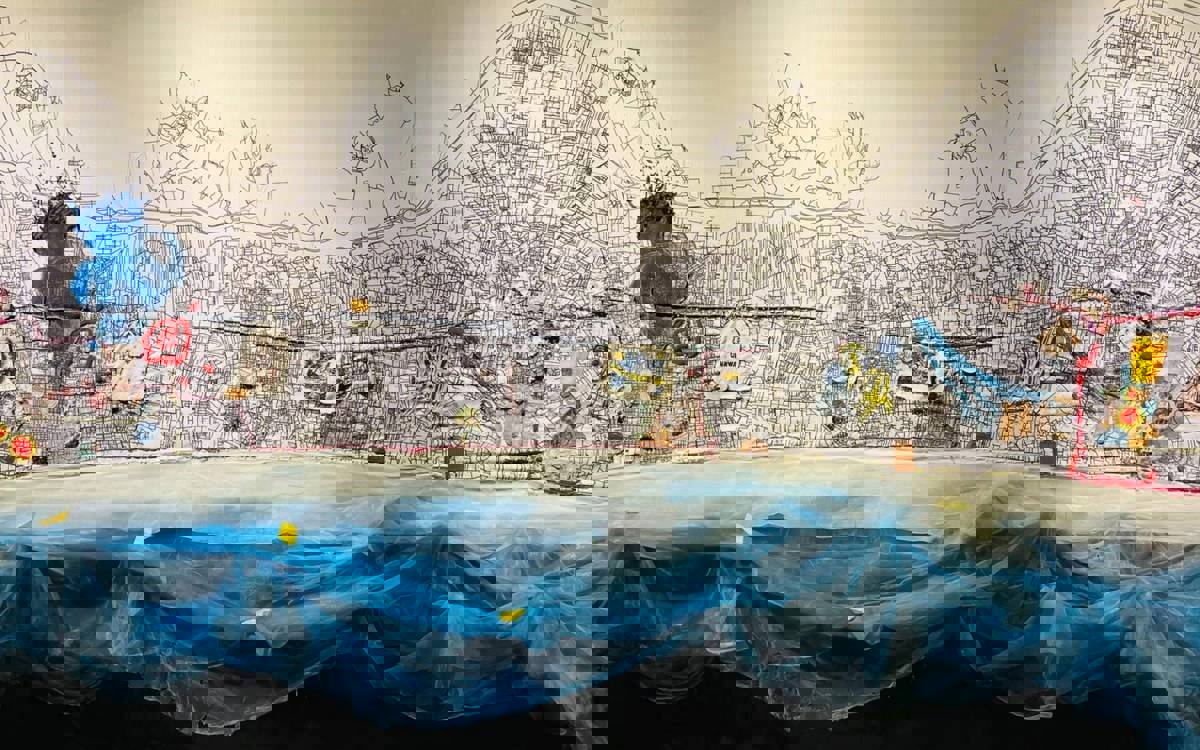
Before the fragile solemnity of a flake of ash floating from a land in mourning, where genocide, the crime of crimes, is exposed before the eyes of the world, Palestinian artists of Gaza speak to the humanness of their struggle for survival. Gasping for breaths of creative integrity, suffocating under the smoke of war, drowning for generations in a blockaded sea, their seers and visionaries emerge in full color, alive.
Depo, legacy project of jailed arts philanthropist and minority rights advocate Osman Kavala, has ever hosted cultural events to parallel the sociopolitical gravity of the İstanbul Pavilion of the Gaza Biennial, a global movement to platform artists from the embattled enclave as an act of solidarity.
The earnest desperation is clear, as the weight of such epochal trauma works in mysterious ways through the space, like the negative of a film reel, the apparition of a ghost, that where there might have only been tragedies of death and the myths of the past, now come paintings, poems, films, sculpture, transporting installations that evoke the beaches, trees, fruit and voices of Gaza.
Whereas artists from Gaza and their works are largely unable to penetrate the occupation and its borderlines of open-air ghettoization, imprisonment and extermination, the curatorial team of the House of Taswir evaded lethal red tape in collaboration with the Gaza Bienniale Initiative, Forbidden Museum of Jabal Al Risan and the Addar Center İstanbul, redrawing the map of exhibition praxis through co-creation, ghostwriting, tele-conversations and other adaptations on the idea of the presence of the artwork, its aura, to bypass the deadlocked conflict between Israel and Palestine with respect to the international isolation of cultural practitioners in Gaza.
Across two floors at Depo’s historic tobacco warehouse, the Gaza Biennial’s İstanbul Pavilion, titled, A Cloud in My Hand, speaks to the ethereal nature of artworks and the deadly struggle to produce, exhibit and program productions of Palestinian culture amid open genocidal calamity.
Such non-Palestinian artists of certain global notoriety, such as Alfredo Jaar and Shirin Neshat, contributed to İstanbul’s pavilion in solidarity with the absence of artists from Gaza either dead, incarcerated or confined. And yet, it is the more obscure, local figures of Gaza whose artworks come to the fore in A Cloud in My Hand with special resonance.
The piece, Earth Memory (2025), from the printmaking series by Gaza-native, refugee artist and journalist Ashraf Sahwiel introduces A Cloud in My Hand, offering a bitter vision of a family on the move under a canopy of olive trees, the edges of the frame blackened over their heads with dreadful opacity, yet they walk tall, buoyant on a multigenerational course beyond the frame, toward an unknown future where the light seems to narrow to naught. They might be coming from an eviction or bombing, displaced anytime from 1948 to the present, they are the people of Palestine.
Born in 1973, Sahwiel represents a generation of Palestinians from Gaza that have lived with the increasingly dire prospects of national or even cultural sovereignty. Five years ago, as chairman of the board of directors of the Gaza Center for Art and Culture, Sahwiel spoke with Human Rights Watch, saying he had “given up hope on the possibility to travel” as permits are rarely granted through Israeli authorities.
His prints, although black-and-white, are suffused with a hopeful light, displayed generously over the walls of Depo. They are also for sale, with all proceeds directed to the artist himself. This is the case with works throughout the show. It is also a benefit, an emergency incarnation of perhaps the 21st century’s grandest cause célèbre within the Western world.
The howl of sheer humanity, deep as earth, issues from the kiln clay work, Life (2024) by Yasmeen Al Daya, that of a person’s visage, their ears cut off, eyes blank, mouth open, yet, silent as burial dirt against the recurring blackness of the background, the original piece assuming a diasec print in the face of the unbridgeable gap that martyrs Palestinian contact with the world.
An affecting, multi-sensory immersive installation, What Will We Do Without Exile? (2025) by Basel Zaraa, includes a tent, trees, carpets, and serves to illuminate the survivor’s imagination, that of a world bruised and haunted by the loss of innocent life, of the dream that is a free and independent Palestine.
Stepping onto that artificial patch of earth inside Zaraa’s world, it is difficult not to feel for the millions of people who have pined for nothing more than to see and smell another overripe orange, fallen from its branch, rotting to expiration on that place where they might once have called home enough to live a life so full as to have as natural a death. (MH/VK)