Physical Address
Indirizzo: Via Mario Greco 60, Buttigliera Alta, 10090, Torino, Italy
Physical Address
Indirizzo: Via Mario Greco 60, Buttigliera Alta, 10090, Torino, Italy
Speaking to journalists during a return trip to Türkiye from Azerbaijan on Saturday, President Recep Tayyip Erdoğan said the Turkish foreign minister and intelligence chief would be part of a delegation to Pakistan this week to resolve issues between Pakistan and Afghanistan.
On Sudan, Erdoğan said Ankara would not just watch what was happening in the country locked in a dire conflict and said diplomatic efforts would continue.
Erdoğan also touched upon normalization with Armenia and said they were “in sync” with Azerbaijan in their push for the revival of ties with Armenia.
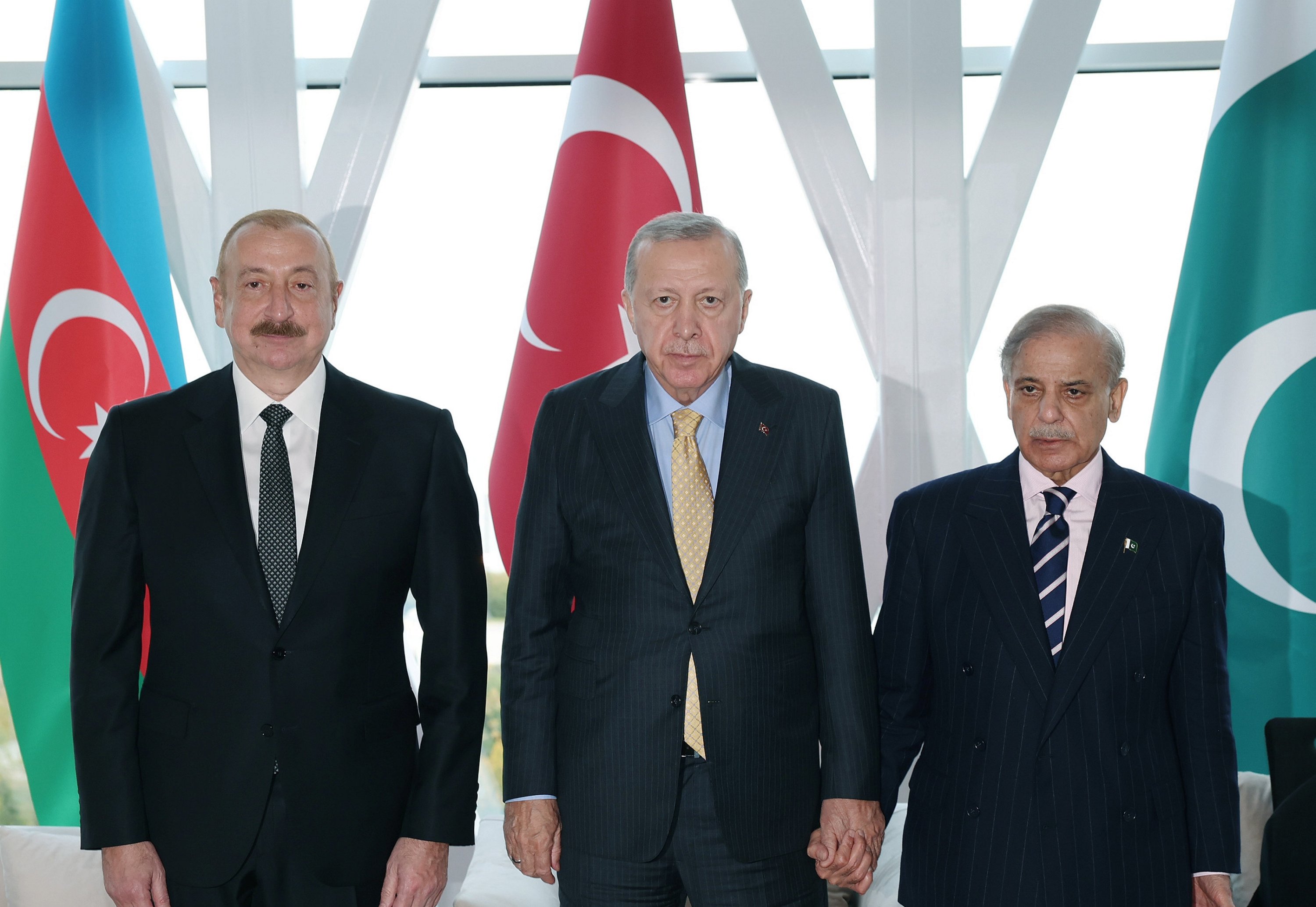
The Turkish leader has joined Azerbaijani President Ilham Aliyev and Pakistani Prime Minister Shahbaz Sharif in Baku on Saturday on the occasion of Victory Day, or the anniversary of the liberation of Azerbaijan’s Karabakh from the Armenian occupation.
The president told journalists in remarks published on Sunday that he had held bilateral talks with Sharif in Baku, both on their countries’ ties and measures to prevent military escalation between Pakistan and Afghanistan. “These are two brotherly countries for us, and together with Qatar, we are working to end this dispute as mediators. Our target is implementing measures and mechanisms for a lasting truce and permanently ending acts of terrorism in the region,” Erdoğan stated. The president said Türkiye’s mediation has been positive, and they hope for a good outcome from the Pakistan-Afghanistan talks.
“This week, Foreign Minister Hakan Fidan, Defense Minister Yaşar Güler and our National Intelligence Organization (MIT) director will travel together to Pakistan. Allah willing, they will pave the way for concluding the process that started in Doha in Ankara. We hope for a lasting truce and peace, and continue advising the sides to act moderately,” he said.
The two neighbors have seen tensions rising after deadly border clashes. The clashes subsided after Qatar mediated a cease-fire on Oct. 19. Since then, representatives of the two countries have engaged in talks in Istanbul for a lasting peace. Mediated by Türkiye and Qatar, the process is the most significant diplomatic effort to resolve problems between the two neighbors since a new administration came to power in Afghanistan four years ago. Although talks have not yielded tangible results so far, the sides remain committed to the cease-fire.
Erdoğan also answered a question on Türkiye’s stance on the ongoing conflict in Sudan. “We have to implement plans first. Sudan is a country always waiting for Türkiye to reach out to them. Every suffering, every massacre there gives us immense pain. They are looking to us and we are working on what we can do for them now,” he said.
The president noted that thousands of people have died in Sudan in the past two years and that millions of others have been displaced, while the children were embattled with starvation and diseases. “What is happening there hurts the conscience of humanity. We believe this dispute should end as soon as possible, and problems should be resolved through dialogue. Türkiye has a heavy burden and cannot simply watch the developments there. We will continue our diplomatic efforts for peace and security in Sudan,” he said. Erdoğan added that the people of Sudan should “rest assured that Türkiye is with them.”
Since April 15, 2023, the Sudanese army and the Rapid Support Force (RSF) have been locked in a war that regional and international mediations have failed to end.
Türkiye’s rising profile in diplomacy under the leadership of Erdoğan reaps results in peace-making efforts. Erdoğan’s recent visits abroad were all aimed at advancing peace efforts in conflicts around the world.
The veteran politician has reshaped Turkish foreign policy to safeguard Türkiye’s interests and the rights of the oppressed.
In the Karabakh conflict, a major issue for friendly Azerbaijan, Erdoğan voiced Türkiye’s support in Baku’s fight against the Armenian occupation. The president’s military and political support ended in the resolution of the issue in 44 days, with Azerbaijan’s victory in the Second Karabakh War that began on Sept. 27, 2020. It effectively ended 26 years of illegal Armenian occupation and helped Azerbaijan to liberate its lands.
Erdoğan’s diplomatic efforts and support for the elected legitimate government helped Libya end the political turmoil that began in the post-Gadhafi era. Libya has moved from a process where armed militia backed by international actors attempted to force their way into the capital, Tripoli, for a coup and heightening conflict to a change of balance in power, thanks to Türkiye’s support.
The winds of peace prevailed in Africa, which had long been subject to the West’s imperialist designs, following Erdoğan’s mediation efforts. In 2024, the president stepped in to resolve the crisis between Somalia and Ethiopia. He hosted Somalia’s President Hassan Sheikh Mohamud and Ethiopian Prime Minister Abiy Ahmed at the Presidential Complex in Ankara. What followed was a news conference with the two leaders on each side of Erdoğan, who announced that the sides had reached a compromise in their conflict. Prior to that, Türkiye had hosted rounds of talks between Somalia and Somaliland in 2013 and 2014, laying the groundwork for future negotiations.
In 2021, Türkiye offered to mediate between Egypt and Ethiopia following a dispute over the construction of the Grand Ethiopian Renaissance Dam. Türkiye also reached out to Ethiopia to mediate an end to the conflict in the Tigray region. Also in 2021, Erdoğan offered to mediate in a peaceful solution to a border dispute between Ethiopia and Sudan.
Under Erdoğan’s leadership, Türkiye also served as a broker for peace in the Middle East, joining Qatar and Egypt in mediating Israel-Hamas talks and securing a cease-fire to end Israel’s attacks since October 2023 in Gaza.
The longstanding Assad regime in Syria, which thrived on the oppression of its dissidents, also ended in late 2024 thanks to Türkiye’s political support for the new rulers of the neighboring country.
In a speech last August, Erdoğan said that Türkiye has emerged as a trusted and sought-after actor in international peace efforts, advancing with confidence on both diplomatic and economic fronts while maintaining a principled foreign policy that protects the oppressed and avoids reckless adventurism.
On the Azerbaijan-Armenia peace, Erdoğan said they were pleased with the steps taken to that extent between the two countries, especially the landmark Aug. 8 deal agreed on in the United States.
Erdoğan said the window of peace opened in the southern Caucasus after more than 30 years of stability.
“A successful conclusion to the peace process will make Azerbaijan, the victor in the Karabakh war, an architect of peace,” he stated.
Türkiye and Azerbaijan have solid ties as two allies united under the motto of “two states, one nation,” referring to their Turkic identity. Erdoğan noted that Türkiye would support Azerbaijan “to the end” during the Karabakh war, and Turkish armed drones have became a symbol of this solidarity. “After the victory, winds of peace are blowing in the region,” he said.
In parallel with Azerbaijan’s dispute with Armenia, Türkiye has suspended ties with Armenia since the 1990s. Erdoğan said now they were synchronizing their efforts with Azerbaijan for normalizing Ankara’s ties with Yerevan.
Türkiye and Armenia reiterated their determination to pursue normalization of ties without preconditions and agreed to speed up the process to open border crossings between the two neighbors, as special representatives for the normalization process, as they met for the sixth round of talks in September.
Türkiye and Armenia have held five rounds of normalization talks in recent years, seeking to restore diplomatic ties and reopen borders closed since the early 1990s.
The two countries share a complex history. Armenia, for a long time, has accused Türkiye, or rather, the Ottoman Empire, of committing “genocide” against the Armenian population in the country during World War I. Türkiye has repeatedly denied the claims, although it has acknowledged a high number of deaths among Armenians due to isolated incidents and diseases.
Borders have remained closed since 1993 following Armenia’s illegal occupation of the Azerbaijani territory of Karabakh. Relations began to thaw after the 2020 Karabakh war, with both sides appointing special envoys to pursue normalization talks and negotiating the reopening of their land border. So far, limited agreements have allowed third-country citizens and diplomats to cross, but a full reopening remains elusive.
Despite the hurdles, there have been tentative gestures toward cooperation. The Margara border crossing has been used twice in recent years for humanitarian purposes: in February 2023 to deliver Armenian aid trucks following a devastating earthquake in southeastern Türkiye, and in March 2024 for humanitarian aid shipments to Syria via Türkiye. Armenia has also upgraded the crossing in anticipation of future use.
Erdoğan also commented on the situation in Gaza, where a tentative cease-fire is in place. Responding to a question about aid delivery to Gaza, Erdoğan said they were mobilized to “deliver what our nation entrusted to us to our Palestinian brothers and sisters,” he said. He noted that their 17th “Goodness Ship” carrying aid reached Egypt’s al-Arish port, but the aid corridor was deliberately obstructed (by Israel).”
“They were supposed to allow 600 trucks carrying aid daily to Gaza, but this promise was broken,” Erdoğan lamented. He said Ankara is in talks with allies for the planning of aid. “It is crucial to deliver emergency aid to Gaza. This is a matter of humanity. We transported food, medicine, clothes, etc. And continue transporting them,” he underlined.
On a question about Türkiye’s acquisition of fighter jets from abroad, namely F-35s from the United States and Eurofighter jets from Europe, Erdoğan said there have been positive steps with the United Kingdom and Germany for Eurofighters. The British prime minister and German chancellor met Erdoğan in a span of a few days recently, and the U.K. and Türkiye signed a deal for Eurofighters during the prime minister’s visit. The jets are manufactured by a consortium of European countries, including the U.K. and Germany.
Erdoğan noted that they were also engaged in talks with Qatar and Oman for the possible additional purchase of secondhand Eurofighters that those countries had. “If we can conclude all these talks, we will have positive developments ahead. In parallel with these, our defense industry is taking leaps (for producing locally-made aircraft).
On the F-35 issue, Erdoğan said his last meeting with U.S. President Donald Trump led to “good steps” on this matter. “I hope their promises will be fulfilled and we will be stronger with F-35 jets,” he said.
Türkiye was removed from the U.S.-led multinational program building and buying the jets in 2019, and Washington imposed Countering America’s Adversaries Through Sanctions Act (CAATSA) sanctions following its purchase of Russian-made S-400 missile defense systems.
Another issue on Erdoğan’s agenda was Türkiye’s aging population and boosting the number of families as the country declared 2025 “Family Year.”
Erdoğan said building families was crucial for Türkiye ,and they had to safeguard the institution of the family from “attacks.”
“We have to march to the future with strong steps. We cannot go astray in this march. Unfortunately, we have a 1.7% population growth rate. This is self-destructive, and we cannot allow it to go on at this rate,” he said. Erdoğan repeated his famous advice to couples to have at least three children and said this may very well be “four or five children.”
“We have to accelerate the growth,” he stressed.