Physical Address
Indirizzo: Via Mario Greco 60, Buttigliera Alta, 10090, Torino, Italy
Physical Address
Indirizzo: Via Mario Greco 60, Buttigliera Alta, 10090, Torino, Italy

A team of international astronomers, led by Turkish doctoral student Selçuk Yalçınkaya, has unveiled four new exoplanets – one of which lies tantalizingly within its star’s habitable zone. The discovery, part of Yalçınkaya’s Ph.D. research at Ankara University’s Institute of Science, was published in the prestigious journal Astronomy & Astrophysics.
Supported by the TÜBITAK 2214-International Research Fellowship Programme for Ph.D. Students, Yalçınkaya conducted part of his work at the University of Liege in Belgium, while continuing his observations in Türkiye. Collaborating with a global team that includes Nobel laureates, he applied the transit method – one of astronomy’s primary techniques for discovering exoplanets – to study several stars and uncover these distant worlds.
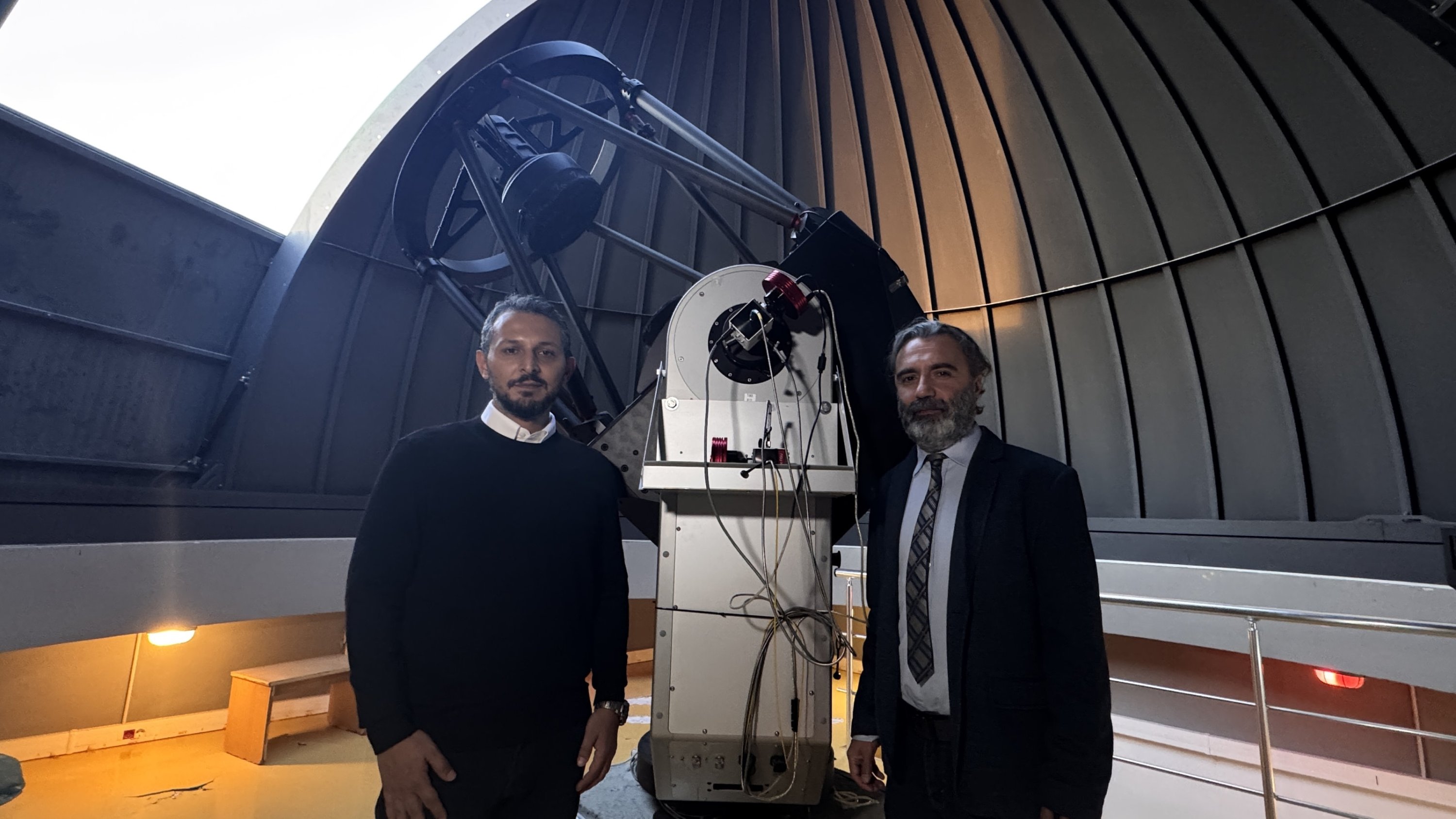
Using telescopes at Ankara University’s Kreiken Observatory (AUKR) and the Turkish National Observatory (TUG), as well as nearly 20 instruments around the world – from Chile and Mexico to the Canary Islands – the team confirmed four exoplanets: two orbiting the small, cool star TOI-5799 and one each around TOI-1743 and TOI-6223.
Each exoplanet tells its own story. TOI-6223b is a hot Neptune, comparable in size to Neptune in our solar system, yet orbiting so close to its star that it sizzles under intense heat. Its atmosphere remains a mystery, awaiting future observations.
TOI-1743b is a super-Earth roughly 70% larger than Earth. It orbits extremely close to its star, completing a full revolution in just four days. The intense radiation it receives likely stripped away its atmosphere long ago, leaving a rocky, scorched world.
The TOI-5799 system is especially exciting. This system hosts two super-Earths, TOI-5799b and TOI-5799c, each about 70% larger than Earth. TOI-5799b orbits its star in just four days, making it far too hot to support life. In contrast, TOI-5799c occupies the star’s habitable zone, completing a 14-day orbit. Its estimated surface temperature is around 63 degrees Celsius (145.4 degrees farenhiet), though actual conditions could differ depending on its unknown atmosphere.
Yalçınkaya emphasizes that TOI-5799c is particularly promising for future study. Its location on the inner edge of the habitable zone, combined with the potential for an atmosphere, makes it one of the few rocky exoplanets where scientists could search for biosignatures – subtle signs of life. This position also makes TOI-5799c an ideal candidate for observation by the James Webb Space Telescope (JWST).
The journey to these discoveries began with data from the TESS space telescope, which scans the sky for transit signals – tiny dips in starlight caused when a planet crosses in front of its host star. Yalçınkaya explains that after identifying these initial signals, the team confirms their origin using ground-based telescopes, including the 80 cm telescopes at AUKR.
“By observing from multiple locations on Earth, we can determine whether a signal genuinely comes from the target star or from nearby stars,” Yalçınkaya says. “Once confirmed, we perform additional experiments to understand the nature of the signal and verify the planet’s presence.”
This collaborative, international approach, combining telescopes from around the world, was essential to the success of the project.
Professor Özgür Baştürk, Yalçınkaya’s thesis adviser, highlights the potential of TOI-5799c. “The next step is to study its atmosphere. Using JWST, we can observe its transits and investigate whether it has an atmosphere, and if so, whether it contains features that could indicate life. This planet is among a rare few rocky worlds where this is even possible.”
Baştürk emphasizes that discovering a planet in the habitable zone does not mean life exists there. “But TOI-5799c is a prime candidate. Its location, size, and potential for an atmosphere make it one of the most exciting exoplanets for future research.”
The discoveries not only add four new worlds to humanity’s cosmic map but also demonstrate the power of international collaboration and advanced observational techniques in the search for potentially habitable planets beyond our solar system.