How fragmented is Somalia and why does Somaliland insist on independence
Somalia was formed by unifying territories formerly controlled by the British Empire with areas previously ruled by Italy, all inhabited by ethnic Somali populations. The society is deeply tribal. Each tribe maintains its own ideology and a distinctly different way of life. The Issa tribe, which dominates Somaliland, is considerably more pragmatic and rejects radical Islam, whereas other tribes actively embrace it.
Since the outbreak of Somalia’s civil war in 1991, the state has effectively disintegrated into competing tribes locked in continuous conflict.
The Issa tribe declared the independence of the State of Somaliland and proceeded to establish functioning state institutions and government ministries, a multi-party democratic system, and levels of corruption far lower than those typically seen in Africa – certainly far lower than those of the dysfunctional government in the capital, Mogadishu.
The people of Somaliland have succeeded in insulating themselves from the civil war, famine, and chronic instability that characterize the rest of Somalia. They have built an economy based on agriculture, fishing, light industry, and trade. Consequently, they have no incentive to reintegrate into a larger, bleeding, and non-functioning Somali state.
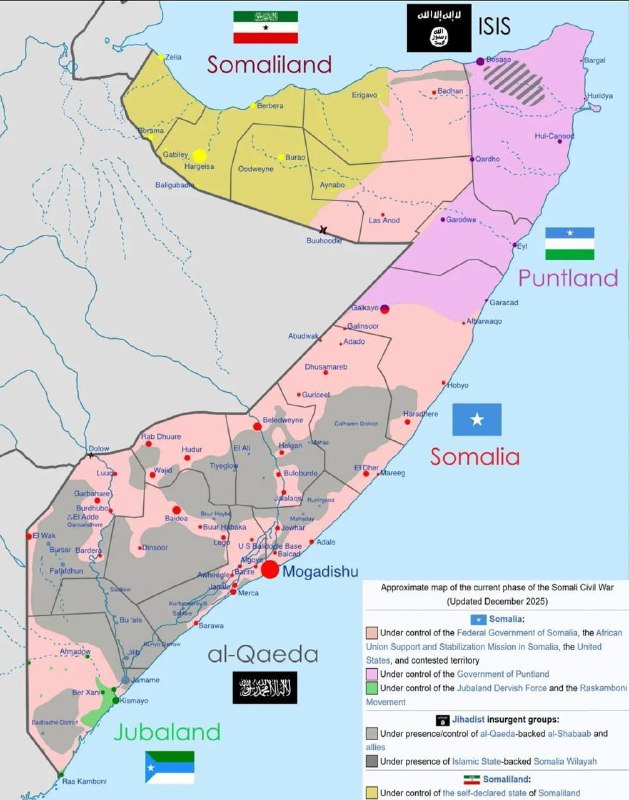
The different colors on the map reflect the fragmentation caused by the civil war:
• Peach-pink areas: Territories controlled by the federal government, including the capital, Mogadishu.
• Fuchsia-pink areas: The autonomous Puntland administration.
• Gray areas: Territories controlled by al-Shabaab, an al-Qaeda affiliate.
• Black area in northern Puntland: Territory controlled by a local militia affiliated with ISIS.
• Mustard-yellow area: Territory controlled by the government of Somaliland.
Somaliland – formerly a British colony – is, in practice, larger than the territory currently under the effective control of its government. While the government claims sovereignty over eastern Somaliland as part of its lawful territory, it does not presently exercise control there. It is possible that one form of assistance the Somaliland government may seek from Israel is military support to reclaim the eastern part of the country and enforce its sovereignty over it.
The capital, Hargeisa, is located on the inland plateau at an elevation of 1,611 meters above sea level. The principal port city, of significant strategic value, is Berbera.