Physical Address
Indirizzo: Via Mario Greco 60, Buttigliera Alta, 10090, Torino, Italy
Physical Address
Indirizzo: Via Mario Greco 60, Buttigliera Alta, 10090, Torino, Italy

Considered the pinnacle of Ottoman architecture, the Süleymaniye Mosque and Complex has maintained its grandeur since its opening in 1557, serving not only as a place of worship but also as a center of knowledge, art and civilization that shapes the spirit of Istanbul.
Despite enduring earthquakes and fires, Süleymaniye has largely preserved its originality. Comprehensive restoration works, which began during the Republican era, have meticulously protected both its architectural details and its acoustic design.
With restorations most recently carried out in the 2010s, the mosque and complex have been restored to their former glory and are listed as a UNESCO World Heritage Site.
Historian and author Ibrahim Akkurt evaluated the historical and cultural significance of the Süleymaniye Mosque and Complex, emphasizing its meaning in the city skyline over the centuries.
Akkurt noted that the complex was built between 1550 and 1557 by architect Mimar Sinan under the order of Sultan Suleiman the Magnificent.
“Süleymaniye is not an ordinary mosque or a simple complex. It reflects the 200-250 years of accumulated knowledge of the Ottoman Empire during its most magnificent period, as well as the life-long experiences of both Sultan Suleiman and Mimar Sinan during their most accomplished years,” he said.
Akkurt highlighted that, surrounding the central mosque, the complex originally included four madrassas, a bathhouse, a hospital and an imaret (public kitchen), serving as the social heart of the area. He explained the original functions: “About 750 people worked here daily. Free meals were provided to 2,500 people, benefiting both the rich and the poor. In this way, it brought together all layers of society at the same table, forming a system that integrated the entire community into the social life of the Süleymaniye Complex.”
“This was possible not only because of Sultan Suleiman’s charitable vision but also because Mimar Sinan, having studied architecture in places like Iran, Egypt under Yavuz Sultan Selim and Western Europe under Suleiman, synthesized all these influences into a single work. The complex is located on a hill parallel to Hagia Sophia, making it a continuation of Hagia Sophia. Mimar Sinan sends a message that he developed and enhanced what was inherited from there in this masterpiece,” he added.
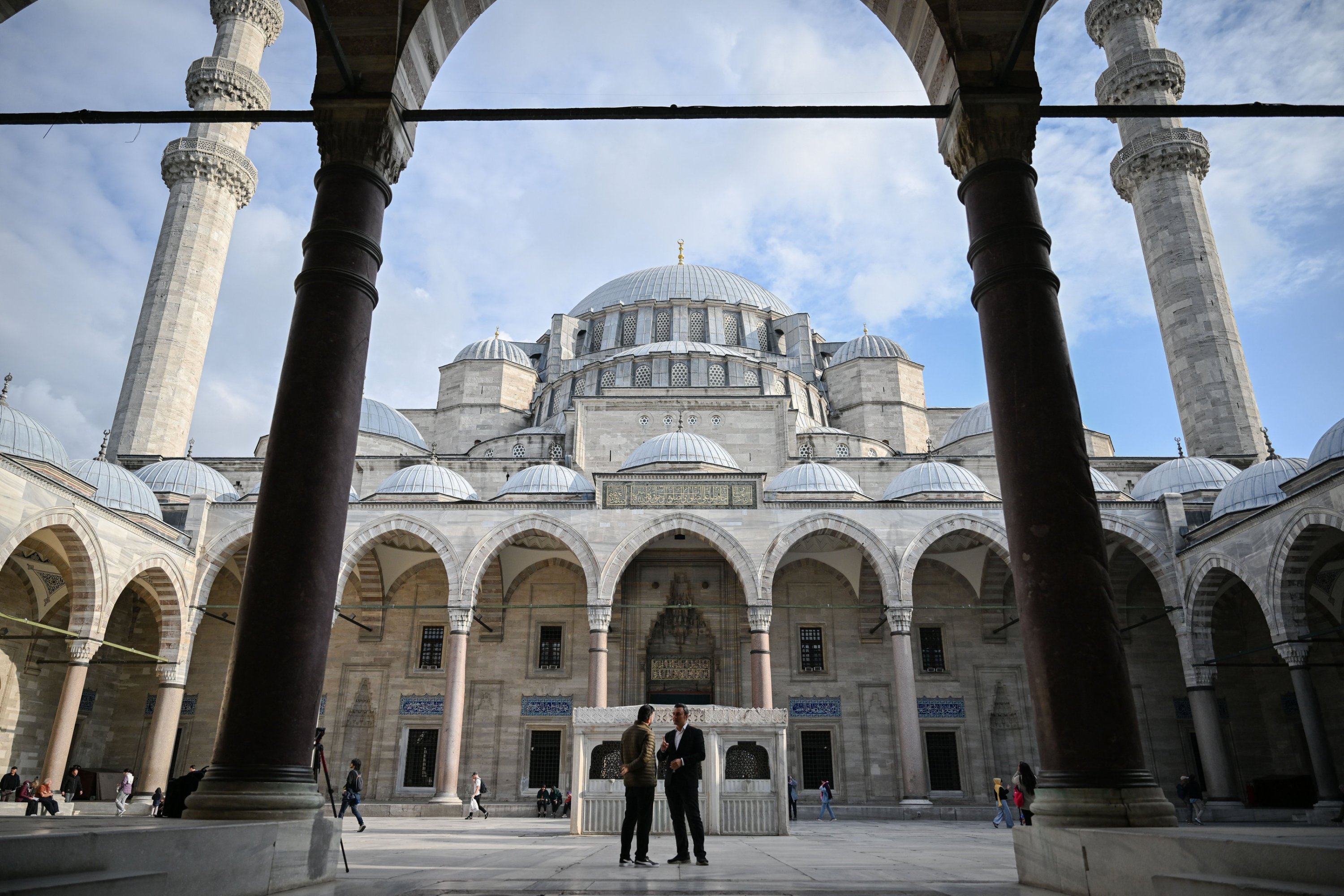
Akkurt explained that during the mosque’s construction in 1553, Venetian envoys were guided through the site under the supervision of Rüstem Pasha, noting that among the many works commissioned by Sultan Suleiman, the one that became most renowned by name is the Süleymaniye Complex.
He also referred to Evliya Çelebi’s Seyahatname, which describes the mosque’s garden as a public picnic area: “When the Süleymaniye Complex was built, neighborhoods surrounded it. Not only did residents of these neighborhoods come, but visitors curious about one of Islam’s greatest mosques also traveled to see it. This continues to this day.”
Akkurt emphasized that Sultan Suleiman intended this work to leave a mark on Istanbul and future generations, explaining: “Contemporary constructions like Notre-Dame Cathedral in France took 180 years, St. Peter’s Basilica in Rome 130 years and churches in England 100 years. But those are single buildings. The Süleymaniye Complex, however, was completed in only seven years through Mimar Sinan’s and his architectural team’s extraordinary efforts. Mimar Sinan is said to have created nearly 400 works, and among them, Süleymaniye is one of his most treasured pieces, with his home built right beside it.”
Akkurt pointed out that the complex hosts various trees, including the symbolic Ottoman plane and cypress trees, as well as linden trees that give off a pleasant fragrance. He noted: “Although the complex was once the center of Istanbul’s social life, today it is mainly visited by tourists. The mosque has a terrace on the Golden Horn side where visitors can enjoy the view. However, to truly understand its spirit, one must study the period of Mimar Sinan and Sultan Suleiman and watch related documentaries.”
He further mentioned that there is an ongoing effort to revitalize the Süleymaniye Complex through a university, highlighting that it has potential for more active use.
Regarding the importance of establishing a museum dedicated to Mimar Sinan, Akkurt said: “The mosque is a place for gathering and social life. Therefore, the Süleymaniye Complex and other similar complexes can be functional and preserved. These works belong to us, but if we do not take care of them, they cease to be ours. In the garden of Süleymaniye, Yahya Kemal’s poem ‘Bayram Sabahı at Süleymaniye’ could be placed to convey the intended emotion to visitors.”