Physical Address
Indirizzo: Via Mario Greco 60, Buttigliera Alta, 10090, Torino, Italy
Physical Address
Indirizzo: Via Mario Greco 60, Buttigliera Alta, 10090, Torino, Italy

It is a curious truth of cultural history that some nations discover themselves only when one of their own holds a mirror for reflection, not a literal mirror, but one polished by scholarship, stubbornness and an imagination disciplined enough to turn national memory into a durable institution. Osman Hamdi Bey, often simplified into a painter, museum director or archaeologist, belongs to that rare lineage of figures who reinvent the identity of a place before the place is aware it even possesses such an identity. To write about him is to explore the moment Türkiye began thinking of itself not merely as an imperial territory stretching from the Balkans to Arabia, but as a layered cradle of antiquity, a geography with millennia of civilizational sediment compressed under its soil.
And Osman Hamdi did not unearth ruins simply out of romantic enthusiasm; he institutionalized cultural memory at a time when the Ottoman Empire struggled to protect even its present. His legacy stands precisely at the intersection where aesthetics, archaeology, bureaucracy and intellectual eccentricity meet. This makes him not only an artist of singular sophistication but also a character whose life reads like an unlikely novel written in several genres at once: part historical drama, part adventure narrative, part psychological portrait of a man caught between East and West, tradition and modernity, empire and nationhood.
To understand him, one must first grasp the extent of that duality. Born into a household where European education was both aspiration and anxiety, he grew up witnessing the Ottoman Empire wrestle with its own identity. His father, Ibrahim Edhem Paşa, embodied a life shaped by displacement, reinvention and statecraft; his son, in contrast, would chart a path shaped not by political necessity but by cultural imagination. Paris, where he was sent under the pretext of legal education, opened the doors not to law but to painting studios, intellectual salons and the visual vocabulary of Western art. Yet even in this heady environment, Osman Hamdi resisted the gravitational pull of Orientalist fantasies that dominated European depictions of the East. While Gerome and his peers conjured harems, odalisques and languid exotica, Osman Hamdi turned his gaze toward scholars, manuscripts, architectural spaces and moments of interior thought. His East was not eroticized but intellectualized; it was not a spectacle but a contemplative archive.
This sensibility would shape everything he later built. When he returned to Istanbul, he encountered an empire whose cultural heritage was disintegrating beneath the pressures of modernization, foreign excavation and bureaucratic lethargy. Antiquities were being shipped to Europe as imperial gifts or quietly smuggled out; excavation rights were awarded without scientific oversight; the concept of cultural patrimony had yet to find legal footing. Into this landscape stepped a man who had seen how Europe protected its past and refused to accept that the Ottoman lands – home to Hittites, Greeks, Romans, Byzantines and countless forgotten civilizations – should be left vulnerable to plunder.
The transformation he initiated was slow, deliberate and often obstructed by the very institutions he served. Yet it is precisely this slowness that makes his story extraordinary. Osman Hamdi was not the type of reformer who arrived with sweeping proclamations; he was a patient architect, building structures, habits and legal frameworks that would eventually outlast the empire itself. The museum he inherited was a ceremonial repository; the museum he built was a research institution that demanded gloves, catalogues, proper storage, scientific excavation reports and a professional respect for the dead. He wrote antiquities laws with a clarity that startled even European diplomats who had long viewed Ottoman lands as an archaeological buffet. For the first time, artifacts discovered on Ottoman soil were required by law to remain there.
This legal revolution found its dramatic climax in the Sidon excavations. The story has an almost cinematic texture: an Ottoman gentleman-artist traveling to Lebanon, supervising the digging of ancient necropolises, sleeping in the excavation tent to prevent opportunists from stealing the finds and ultimately unearthing the Alexander Sarcophagus, a monument so extraordinary that scholars initially assumed it must belong in a European museum. Yet Osman Hamdi insisted it travel to Istanbul, where he personally oversaw its installation. When he instructed staff to handle the marble with gloves, he was not merely giving a technical order; he was announcing a philosophy, a new ritual of respect.
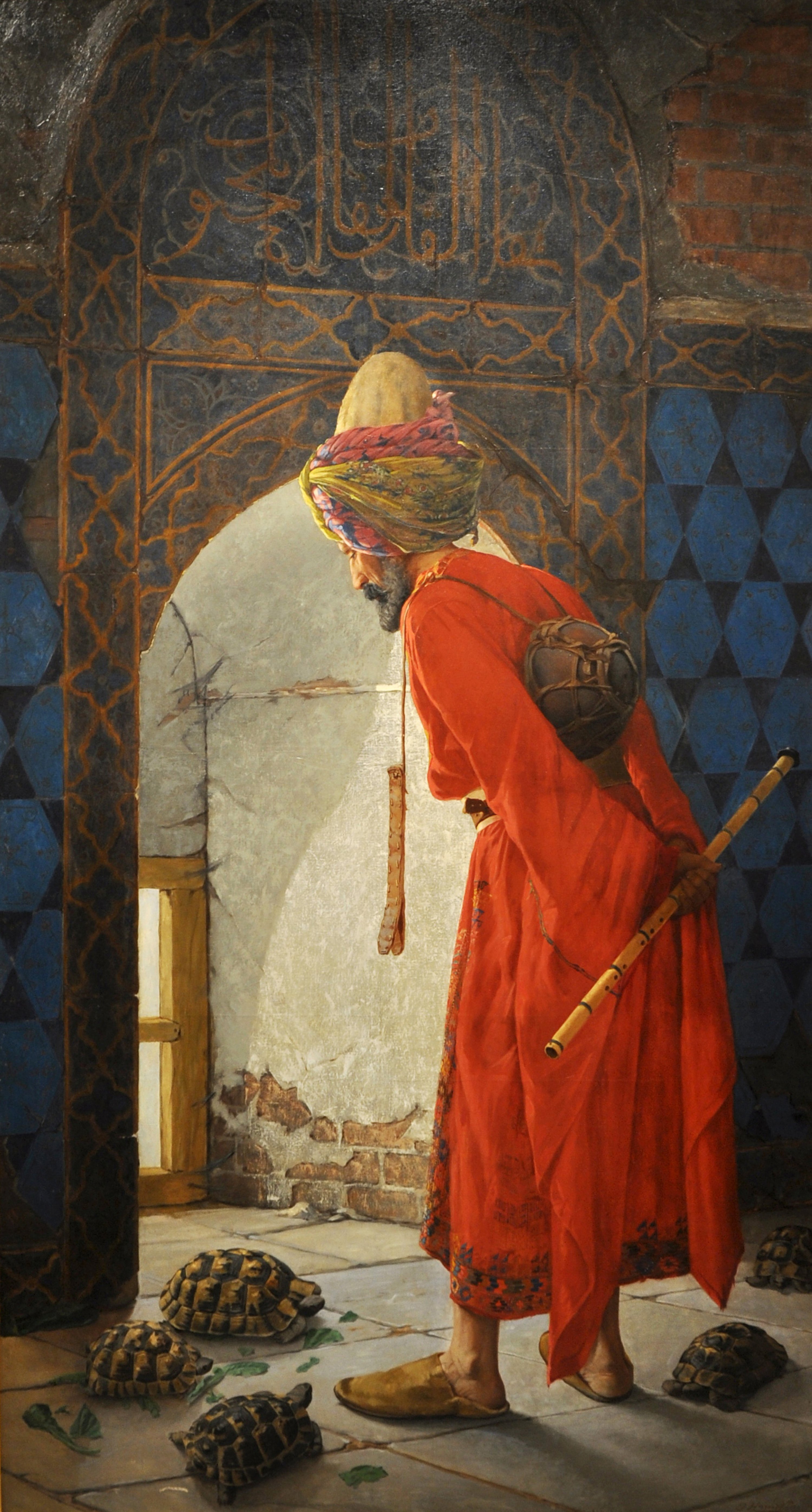
His paintings from this period reveal an equally profound understanding of time. They are meticulous, almost architectural, composed with a scholar’s eye and a storyteller’s soul. In “The Tortoise Trainer,” perhaps his most emblematic work, he encodes the agony of reform into a single theatrical image: a man whose patience borders on desperation, attempting to guide creatures who move at the pace of history itself. Many readers romanticize the image, but its true power lies in its psychological honesty. Osman Hamdi was the tortoise trainer of Ottoman cultural life – urging institutions to reform, coaxing an empire to see value in its past and enduring the maddening slowness of bureaucratic change. It is no coincidence that he kept tortoises in his garden and observed them with almost meditative attentiveness; he understood, perhaps better than anyone, the rhythm of transformation in a place governed by tradition.
Yet beneath his disciplined exterior lay a mosaic of eccentricities. He was known to lecture carriage drivers on architectural history at random; he cared for unusual animals, including an ibex; he worked obsessively through the night, often disappearing into the depths of his museum like a monk tending a sacred archive. He wore European suits but insisted on the Ottoman fez, symbolizing the cultural negotiation that defined his life. Visitors described him as both elegant and enigmatic, capable of intimidating formality one moment and gentle humor the next.
He was also perhaps surprisingly, deeply aware of how history would judge him. When praised for safeguarding antiquities, he dismissed the compliment with a simple line: “I protect what already belongs to us.” And when a European archaeologist challenged his authority at Nemrut, Osman Hamdi replied with a sentence that belongs in the annals of intellectual resistance: “You excavate because we permit you; I excavate because it is mine.” There is a startling beauty in the way he used the word mine, not as a claim of possession but as an expression of guardianship, of geographical intimacy, of cultural responsibility.
In 1910, when he died, the empire he served so diligently was only four years away from a catastrophic unravelling. But his institutions endured. The museum became the heart of the republic’s cultural identity; the fine arts school he founded became a pillar of artistic education; the laws he wrote became the foundation of Türkiye’s cultural policy. More importantly, the consciousness he cultivated – a sense that this land held not just a present but an immense archaeological past – became one of the republic’s intellectual cornerstones.
Today, his canvases appear in exhibitions not as quaint relics of late Ottoman painting but as philosophical meditations on identity, time, and cultural sovereignty. His archaeological work remains a model of integrity in a world where heritage is constantly threatened by conflict and commerce. And his life as a man negotiating the complexities of empire, modernity and cultural memory feels strangely contemporary. In an era increasingly preoccupied with who tells a culture’s story, Osman Hamdi reminds us that the most revolutionary act may simply be to protect, to document and to insist on the value of what is already ours. If he left Türkiye a mirror, it was not one of vanity but of recognition, a surface polished through paintbrushes, legal codes, excavation sites, sleepless nights and the quiet eccentricities of a man who understood, long before anyone else did, that cultural memory is not found; it is built.