Physical Address
Indirizzo: Via Mario Greco 60, Buttigliera Alta, 10090, Torino, Italy
Physical Address
Indirizzo: Via Mario Greco 60, Buttigliera Alta, 10090, Torino, Italy
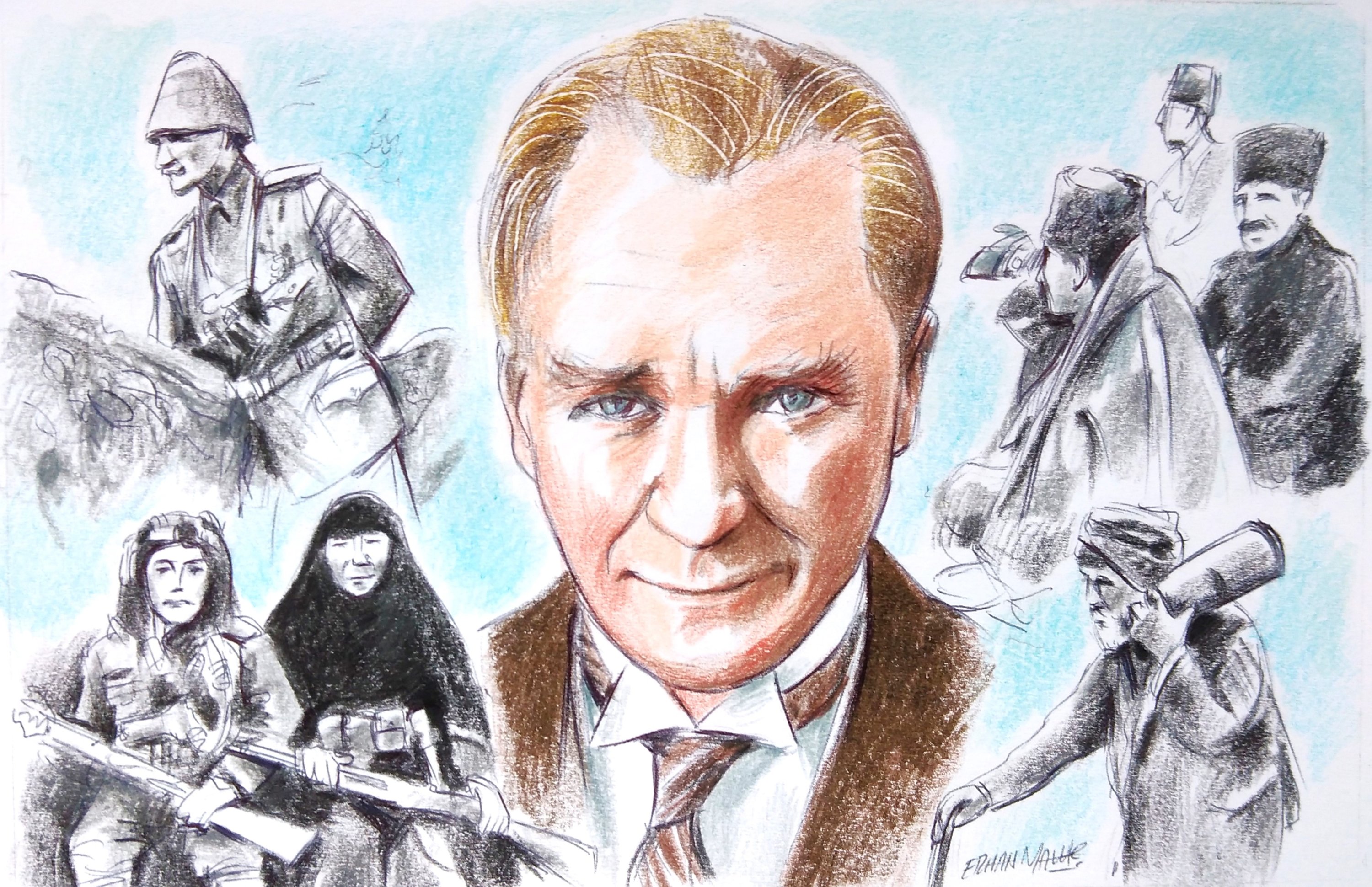
We respectfully commemorate the 87th anniversary of the passing of Mustafa Kemal Atatürk (1881-1938), the founding president of the Republic of Türkiye and commander-in-chief of the Turkish War of Independence.
Born in Salonica (now Thessaloniki), a cosmopolitan city of the Ottoman Empire, as the fourth child of a customs officer father and a housewife mother, Mustafa lost his father at the age of 7-8. After receiving state education, he attended the military secondary school in Salonica, the military high school in Manastır, and the military academy in Istanbul, graduating as a second lieutenant in 1902. Promoted to first lieutenant in 1903, Mustafa Kemal entered the war academies and graduated as a staff captain in 1905.
Mustafa Kemal achieved success throughout his education thanks to his intelligence, determination and diligence. He embraced the name Kemal, given to him by his math teacher at school, and used it throughout his life. He carried out the duties assigned to him during the most difficult times of the Ottoman Empire with attention, care and dedication.
Mustafa Kemal’s first assignment as a staff captain was in Damascus. Then, assigned to the 5th Army, Mustafa Kemal was sent to the 3rd Army in Macedonia in 1907. There, through his friend Fethi Okyar, he joined the Committee of Union and Progress (CUP). Following that, he was sent to Tripoli to prevent the turmoil that arose after the constitutional monarchy and then to Bosnia. After the March 31 Uprising, he came to Istanbul with the Movement Army as an aide-de-camp to Mahmut Şevket Pasha.
In 1909, he participated in the CUP congress held in Salonica as a delegate from Tripoli and argued that “the army and politics should be separated.” He made translations related to the military profession. When Italy invaded Tripoli, he volunteered to go there and organized the local resistance. He was wounded in the eye and returned to Istanbul after receiving treatment in Austria.
He learned of the planned 1913 Ottoman coup, also known as the Raid on the Sublime Porte, and declared his opposition. However, as the coup was successful, he was removed from the capital and appointed as military attache in Sofia. He was still a military attache when World War I broke out. He requested active duty and was appointed commander of the 19th Division in Tekirdağ in 1915.
He drew attention with his successes in the Battle of Gallipoli. His strategy against the British at Arıburnu and Anafartalar ensured victory in the battles. For this reason, he was awarded the Ottoman Order of Distinction. He was also awarded the German Iron Cross and the Bulgarian St. Alexander Order. On June 1, 1915, he was promoted to colonel. He was known as the “Hero of Anafartalar.”
Promoted to general on April 1, 1916, Mustafa Kemal Pasha fought against the Russians on the Eastern Front and against the British on the Syrian Front. He resigned from his post, opposing the appointment of German commanders. He returned to Istanbul. Between Dec. 5, 1917, and Jan. 4, 1918, he accompanied Crown Prince Vahdettin Efendi on his trip to Germany.
This allowed him to meet the future sultan. In February 1918, he received the German Empire’s “Cordon de Prusse” medal. He was sent to Austria due to kidney problems. During this time, Sultan Reşat died and Vahdettin became Sultan. Returning to Istanbul, Mustafa Kemal Pasha had the opportunity to visit the new sultan and express his views. He was assigned to the Syrian front. There, in the face of the British advance, the war temporarily halted as his troops formed a line north of Aleppo.
Then began the Armistice Period – the darkest days of the Ottoman Empire. Mustafa Kemal Pasha returned to Istanbul and sought to enter politics, but this was not possible under the circumstances. He therefore went to Anatolia, where he worked to unite the nation under a single movement for the War of Independence – and he succeeded.
He was elected chairperson of both the Erzurum and Sivas Congresses, and later became the head of the Representative Committee. Mustafa Kemal was elected as a deputy for Erzurum in the general elections of December 1919 and for Ankara in March 1920. When the Grand National Assembly of Türkiye (TBMM) convened in Ankara on April 23, 1920, he was elected its first president.
Mustafa Kemal Pasha waged the War of Independence not by establishing a secret organization, but by leading the TBMM, alongside the nation’s representatives. With the national army, the Battle of Inönü, the Battle of Sakarya, the Great Offensive, and the Battle of Dumlupınar were won, and the enemy was expelled from Türkiye. In addition to being the president of the TBMM, Mustafa Kemal Pasha was appointed commander-in-chief by the Assembly with the Battle of Sakarya.
After the victory, Mustafa Kemal Pasha gave diplomacy a chance, first securing the signing of the Mudanya Armistice and then beginning negotiations for the Treaty of Lausanne. The military successes were crowned with peace in Lausanne on July 24, 1923.
Following the War of Independence and the signing of the Treaty of Lausanne, military and diplomatic victories were successfully transformed into political achievements, paving the way for profound changes in the political sphere. On Nov. 1, 1922, the Ottoman Sultanate was abolished, and on Oct. 29, 1923, the Republic of Türkiye was proclaimed. This established the administrative foundation of the new state, with Mustafa Kemal Pasha becoming the founding president of the republic.
During Mustafa Kemal Pasha’s presidency, the Caliphate was abolished on March 3, 1924. A law passed on Nov. 30, 1925, closed tekkes, zawiyas and tombs. The Hat and Clothing Revolution took place on Nov. 25, 1925. On Feb. 17, 1926, the Civil Code and the Code of Obligations were adopted from Switzerland, the Penal Code from Italy, and the Commercial Code from Germany and Italy.
The reforms were perceived as anti-religious measures and sparked reactions in various parts of the country. Reactions, particularly against the compulsory wearing of hats, were suppressed by heavy penalties imposed by the Independence Tribunals. In 1928, the alphabet reform was implemented, introducing the Latin alphabet. To promote literacy in the new script, the Nation’s Schools were established. This was followed by a language revolution to simplify Turkish. Throughout this process, the government’s policy of aggression against opponents of the reforms increased discontent in society and strained state-society relations. The 1929 global economic crisis had a severe impact on the country’s fragile economy, making it necessary to adopt a policy of direct state control over economic affairs.
In the 1930s, the country moved to planned state control, and the first five-year Industrial Development Plan was implemented (1933). While the global economic crisis accelerated statism in Türkiye, it also strengthened the single-party system, and the merger of the party and the state was announced (1936). Accordingly, the minister of the Interior also became the party’s secretary-general, while governors became the party’s provincial chairs. In 1936, the Montreux Straits Convention was signed, placing control of the Straits in the hands of Turkish soldiers.
Atatürk’s illness became apparent in early 1938, and he passed away on Nov. 10, 1938, at the Dolmabahçe Palace in Istanbul. His body was brought to Ankara with great ceremony and laid to rest in a temporary tomb at the Ankara Ethnography Museum during a ceremony held there on Nov. 21, 1938. After the completion of Anıtkabir in Ankara, built for him, he was laid to rest in his final resting place on Nov. 10, 1953.
Nov. 10, the date of Atatürk’s death, has been commemorated in various ways every year since 1939. From 1939 to 1960, mourning was always at the forefront of the commemoration programs. From 1960 onward, while a day of mourning for Atatürk continued, the period between Nov. 10 and 16 was named Atatürk Week, and Atatürk began to be commemorated with various events throughout the week. This practice, which began after the military coup of May 27, 1960, and was initiated by members of the military junta, the National Unity Committee (MBK), continued until 1988.
In 1988, during the term of Turgut Özal, leader of the Motherland Party and Prime Minister, the official mourning period that had continued for 50 years was lifted on the 50th anniversary of Atatürk’s death, and life returned to normal. However, the official “November 10 Atatürk Commemoration Ceremonies without mourning” continued.
The views and opinions expressed in this article are solely those of the author. They do not necessarily reflect the editorial stance, values or position of Daily Sabah. The newspaper provides space for diverse perspectives as part of its commitment to open and informed public discussion.