Physical Address
Indirizzo: Via Mario Greco 60, Buttigliera Alta, 10090, Torino, Italy
Physical Address
Indirizzo: Via Mario Greco 60, Buttigliera Alta, 10090, Torino, Italy

Ten years ago, I was in Istanbul, the city of empires, history and the sea. At a quiet dinner table, I met a Turkish researcher specializing in Arab relations. He spoke passionately about the Ottoman state archives and the diplomatic correspondence between the sultans of Oman and Istanbul, revealing documents that confirmed the depth of communication between the two sides over the centuries. He told me a sentence I will never forget: “Oman was among the few who addressed Istanbul as an equal, with mutual respect, neither in subordination nor in estrangement.”
That independent spirit was not mere words. The Omani National Records and Archives Authority published a study titled “Oman in Ottoman Documents: Three Hundred and Seventy Years of Historical Relations,” which offers a meticulous examination of 3,838 documents in Ottoman Turkish, French and English, covering the history of Oman, Zanzibar and the surrounding region.
Although Oman never came under Ottoman rule, the two maintained limited military cooperation, especially in securing vessels across Ottoman-controlled areas in the Gulf, notably Basra, where the Omani fleet possessed superior experience in dealing with European ships.
One notable episode occurred in the mid-18th century when Basra was besieged by Persian forces (1775-1777). The Ottoman governor of Basra, cut off from direct Ottoman support, sought help from the Omani Sultan, whose maritime reputation stretched across the Arabian Gulf. Sultan Abdul Hamid I sent a formal letter (the Hümayun Message) to Imam Ahmad bin Said, calling for coordination and assistance.
This cooperation marked a pivotal moment. Imam Ahmad bin Said’s response was not merely an act of solidarity, but a reflection of a deep understanding of the balance of power across the Gulf and the Indian Ocean. Since then, Ottoman records have begun referring to Oman as a “friendly state” – a rare designation in an era when much of the Gulf was under the influence of great powers.
Centuries later, between the wooden ships that once sailed from Oman to Basra and the modern ports connecting Duqm to the Arabian Sea and the Indian Ocean, and Sohar to the Gulf of Oman, the sea remains a domain of influence understood by both Oman and modern Türkiye, which recognizes Oman’s strategic significance.
Türkiye realizes that Oman’s vital ports, such as Salalah, Sohar and Duqm, make it a gateway to East African, Asian and Gulf markets, while its own position at the crossroads of Europe and Asia facilitates access to European and Asian markets. If both sides seize these opportunities, they could build an integrated logistics network linking Omani factories with Turkish markets and vice versa.
Investors are asking how Türkiye can transfer its advanced industries, such as manufacturing, automotive and electronic and electrical appliances, to benefit from Oman’s cost-effective business environment and its proximity to African and Asian markets, as Qatar did with its “Karwa” bus factory in Duqm.
While most Turkish projects in Oman currently focus on construction and contracting, opportunities extend into digital and technological sectors. President Recep Tayyip Erdoğan himself noted that Turkish contractors have delivered notable projects in Oman, reflecting a visible Turkish footprint in the country’s infrastructure.
There is also potential for cooperation in artificial intelligence, digital finance and advanced technologies, alongside joint small and medium-sized manufacturing ventures in electrical devices, marine equipment and food industries, supported by vocational training programs for Omani workers.
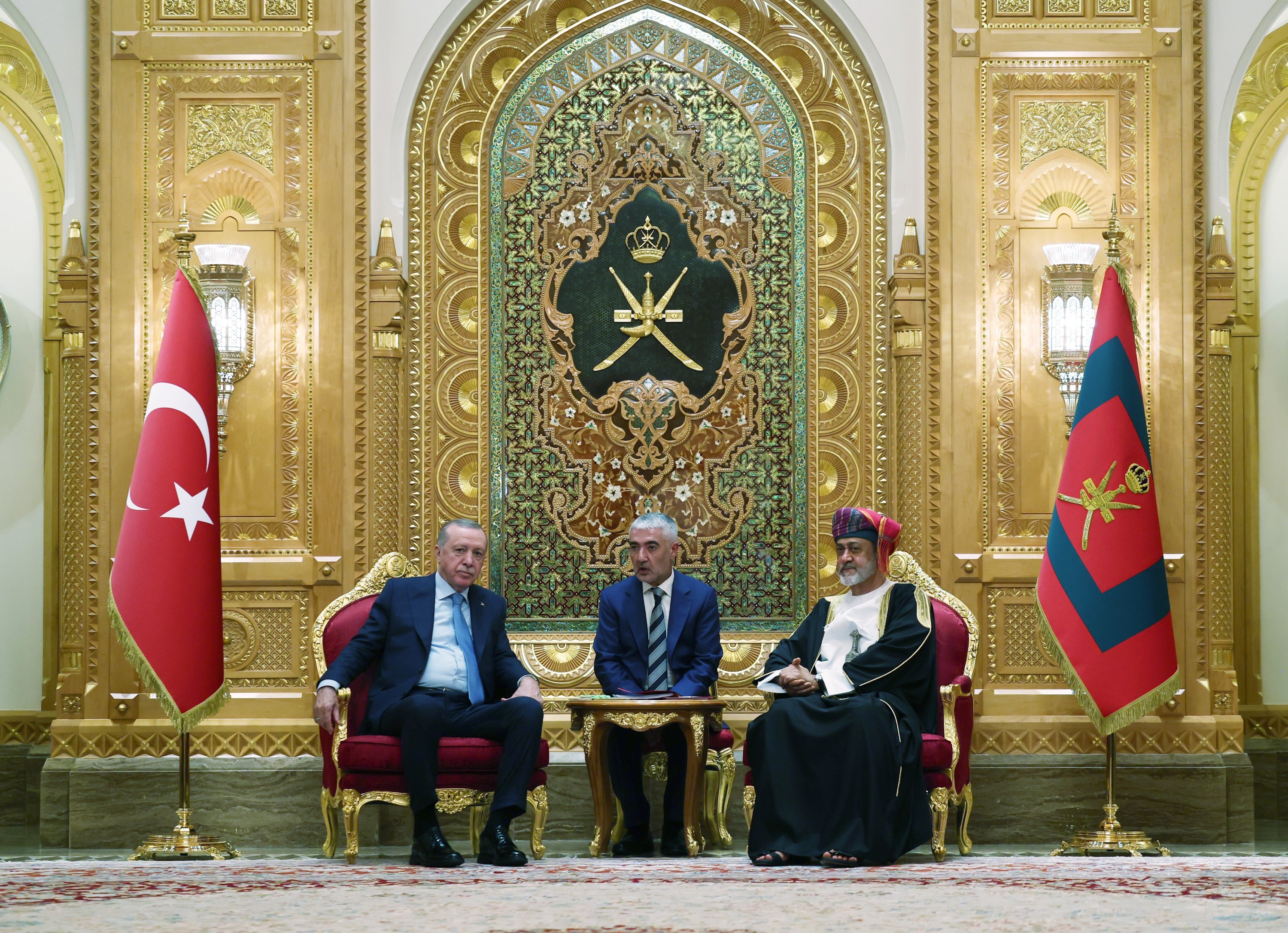
Following Sultan Haitham bin Tariq Al Said’s visit to Türkiye last year, a number of memoranda of understanding were signed. The key challenge now lies in transforming these into tangible projects, especially in agriculture, culture and small and medium-sized enterprises seeking expansion in the Turkish market. At the same time, Erdoğan appears keen on strengthening ties with Oman and increasing bilateral trade, particularly in the energy sector, including LNG exports, while seeking to establish a stronger institutional framework for strategic cooperation.
In the context of regional alliances, and given that both Türkiye and Oman were excluded from the India-Middle East-Europe Economic Corridor (IMEC) linking India, the UAE, Saudi Arabia, Jordan and Israel to Europe, both nations find themselves at a moment of strategic reflection.
Türkiye, despite its reservations about being left out of IMEC, promptly proposed an alternative through the Turkish-Iraqi Development Road, aiming to connect Asia and the Gulf with Europe via Turkish territory.
Oman, meanwhile, represents a complementary route to this economic corridor by relying on its maritime access to the Indian Ocean and its distance from the Strait of Hormuz, offering safer, more stable shipping lanes. However, Oman tends to refrain from direct involvement in the project due to its implicit links to economic normalization with Israel.
So far, Oman is not formally part of the Development Road project announced by Iraq and Türkiye in 2023, although informal discussions between Iraqi and Omani officials have increased, with interest in giving Omani ports a key role in linking the Iraqi-Turkish route to the Indian Ocean.
A major strength of the Development Road lies in the clarity of understanding among the three potential partners – Türkiye, Iraq and Oman (if it joins) – offering greater strategic flexibility than IMEC, which remains vulnerable due to its passage through Israel.
The integrative opportunities from Oman’s inclusion in the Development Road are substantial. Trilateral cooperation between Oman, Türkiye and Iraq could create a flexible axis linking the Gulf, Asia and Europe, balancing major powers while preserving national policy independence.
In the future, incorporating Oman’s Duqm, Salalah and Sohar ports could transform the project into a fully integrated regional network and strengthen its position as an independent global trade corridor. The opportunity lies not only in connecting land and ports but also in turning free zones and industrial areas into economic engines capable of attracting global investment and channeling heavy industries toward Europe, Asia and Africa.
With strategic flexibility in mind, this trilateral axis could become a model for smart regional cooperation, redrawing the logistics and trade map of the region, insulated from international volatility and political pressures.
Ultimately, the success of this Development Road depends on the boldness of Türkiye, Oman and Iraq. The convergence of Türkiye’s expanding industrial base, Oman’s deep and secure ports, and Iraq’s pivotal geography could open vast prospects for an integrated regional trade network, independent of international political fluctuations, parallel to India’s Corridor and China’s Belt and Road. It promises the birth of a balanced, politically neutral alliance and a new economic force that could illuminate the region’s horizons and reshape global trade routes.