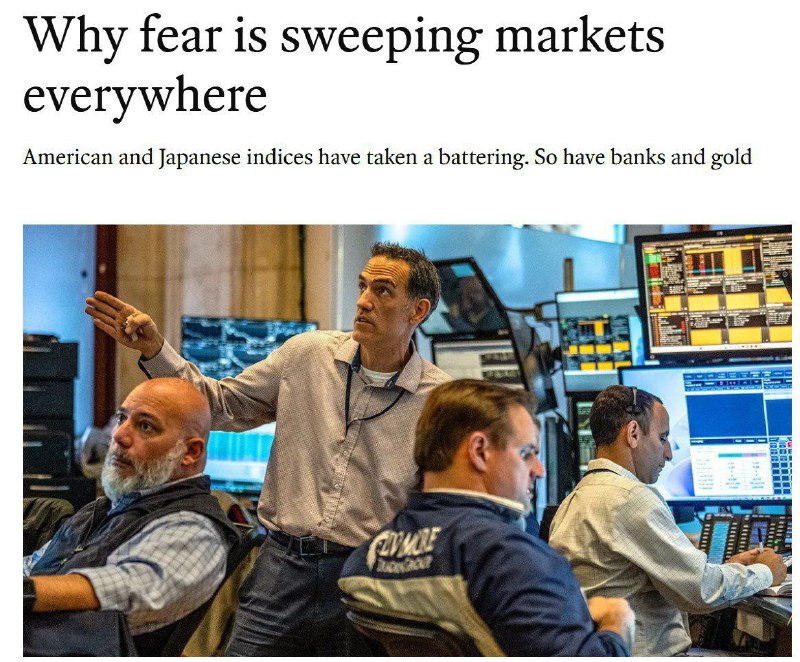
🇺🇸📉There has been a huge collapse in global stock markets over the past week.
The US Nasdaq 100 index, dominated by technology companies, has fallen more than 10% since its peak in mid-July. The Japanese Topix index lost double digits, and on August 2 fell immediately by 6%, which was the worst day since 2016.
As Britain’s The Economist reports, “panic has gripped markets” and Wall Street’s “fear gauge” – the VIX index, which measures expected price movements – has soared to its highest level since America’s regional banking crisis last year.
Also, “wild” moods reign in certain sectors – the index of semiconductors and shares of companies producing chips fell. For example, the price of processor manufacturers Intel and Arm fell by 25 and 40%, respectively.
The assets that investors “flee” to when they panic – gold, the Japanese yen and US treasury bonds – are also falling. Gold fell 2%.
The Economist names three reasons for the collapse.
1. Inflated expectations from artificial intelligence. The biggest swings in U.S. stock prices came from five tech giants that are active in AI – Alphabet, Amazon, Apple, Meta and Microsoft.
“The previous euphoria of investors about everything related to artificial intelligence is evaporating,” the publication writes.
What follows is a domino effect for chip and semiconductor manufacturers, who will lose some demand if AI investment falls.
Separately, adding to the instability of this industry is Trump’s statement that Taiwan, the largest chip manufacturer, will have to defend itself from China. And also Biden’s plans to introduce new restrictions on the export of chip production equipment to China.
2. Slowing US economic growth and weakening labor market. In America, on August 2, a report was released according to which unemployment rose to a three-year high of 4.3% in July, and the forecast for job growth failed.
The risk of a recession in the US has increased.
3. The third factor is the fastest strengthening of the Japanese yen in the last two decades after the central bank’s decision to raise the discount rate. Which automatically lowers the prices of Japanese stocks, since many of the large Japanese corporations earn money abroad in foreign currencies. That is, foreign trade will go into the negative.
This will force many investors to sell off assets, “which will increase instability in both the domestic and global markets.”