Physical Address
Indirizzo: Via Mario Greco 60, Buttigliera Alta, 10090, Torino, Italy
Physical Address
Indirizzo: Via Mario Greco 60, Buttigliera Alta, 10090, Torino, Italy

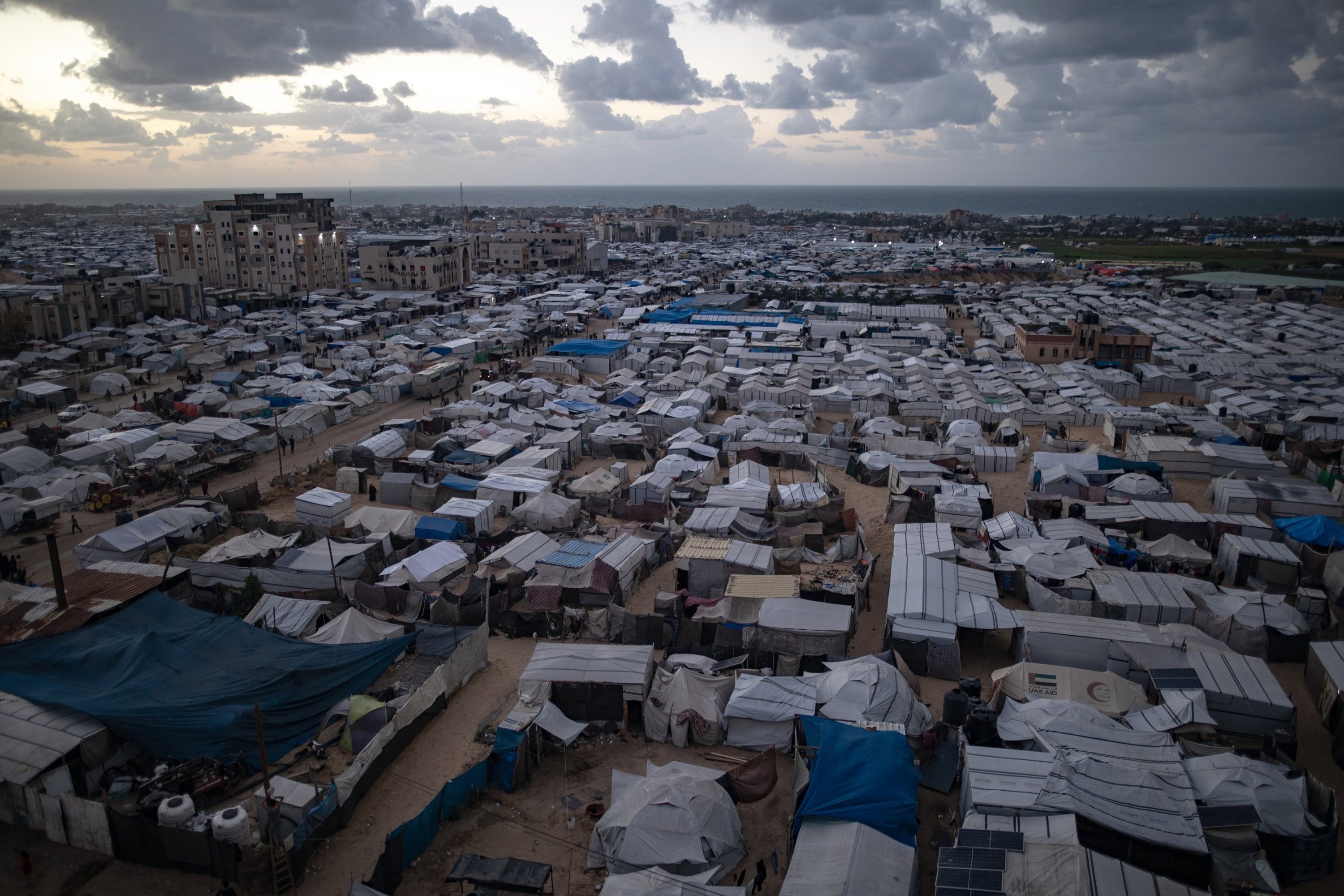
Foreign Minister Hakan Fidan reaffirmed Türkiye’s readiness to shoulder the burden in Gaza and fulfill its responsibilities “with a great sense of duty, including sending troops.”
“This is our clearest message to the international community on this matter,” Fidan said in a televised interview late Saturday.
The Netanyahu administration of Israel adamantly opposes a Turkish presence in the Palestinian enclave. It has been vocal in this opposition, with several Israeli officials insisting that there should not be “Turkish boots on the ground” in Gaza.
Türkiye has been behind a diplomatic blitz to end Israel’s attacks on Gaza since 2023 and mobilized to isolate Israel in the international community, taking part in a genocide case against the Israeli officials and ceasing all commercial ties with Israel. Ankara also advocates a two-state solution recognizing a sovereign State of Palestine with 1967 borders and East Jerusalem as its capital, as the only way for a permanent cease-fire.
The country also backed U.S. President Donald Trump’s peace plan and participated in talks in Egypt, where Israel and Hamas recently agreed to a cease-fire.
Fidan said a U.N. Security Council draft resolution on Trump’s peace plan is still under debate and continues to evolve. He noted that the proposed stabilization force is one of the two structures outlined in the phased plan, and that discussions are focused on shaping a legal framework that would define its mandate and its functioning once implemented.
He stated that discussions are ongoing regarding the establishment of a peace commission and the International Stabilization Force for Gaza, noting that the proposals continue to evolve and the U.S. is working on the issue in consultation with Türkiye.
He noted that preliminary efforts for the stabilization force have begun, including a U.S.-coordinated Civil-Military Coordination Center set up with Israel.
The Civil-Military Coordination Center (CMCC), officially inaugurated Oct. 17, is the first international operational platform established by U.S. Central Command in Israel to monitor developments in Gaza following a cease-fire agreement.
Fidan emphasized that Washington has developed a mechanism to address obstacles in the process, a step he described as important in terms of ownership and commitment.
The U.N. Security Council will vote Monday on a resolution backing Trump’s plan, diplomats said, while Russia submitted a rival draft resolution.
Last week, the U.S. officially launched negotiations within the 15-member Security Council on a text that would follow up on a cease-fire in Israel’s two-year war on the Gaza Strip and endorse Trump’s plan. A draft of the resolution, seen Thursday by the Agence France-Presse (AFP), “welcomes the establishment of the Board of Peace,” a transitional governing body for Gaza that Trump would theoretically chair, with a mandate running until the end of 2027.
It would authorize member states to form a “temporary International Stabilization Force (ISF)” that would work with Israel and Egypt and newly trained Palestinian police to help secure border areas and demilitarize the Gaza Strip. Unlike previous drafts, the latest mentions a possible future Palestinian state. The U.S. and several Arab and Muslim-majority nations, including Egypt, Saudi Arabia and Türkiye, called on Friday for the U.N. Security Council to quickly adopt the resolution.
“The U.S., Qatar, Egypt, the United Arab Emirates, the Kingdom of Saudi Arabia, Indonesia, Pakistan, Jordan and Türkiye express our joint support for the Security Council Resolution currently under consideration,” the countries said in a joint statement, adding they were seeking the measure’s “swift adoption.”
Fidan told A Haber that Türkiye remains determined to advance the mechanisms needed to coordinate progress on the cease-fire agreement, stressing that close dialogue continues between the relevant military authorities.
He said Türkiye played an active role in the Sharm el-Sheikh talks that enabled the Gaza cease-fire, noting that Egypt, Qatar and Türkiye helped bring the agreement into effect. He added that the declaration, signed by the countries, is not a traditional guarantor model but rather reflects their continued political support for the truce.
He noted that Türkiye appointed a humanitarian aid coordinator for Gaza and continues to work intensively to deliver assistance. In contrast, the amount of aid entering the enclave remains below what Israel previously pledged. He also said discussions are underway to form a non-political committee to run Gaza’s daily administration, and Hamas has expressed its readiness to hand over governance to a Palestinian-led body.
Noting President Recep Tayyip Erdoğan’s September meeting with his U.S. counterpart, Donald Trump, he said the two leaders discussed major topics related to relations and regional dynamics. Fidan said Türkiye’s recent “foreign policy performance” and its reliability as a partner have made it “a sought-after actor for cooperation on many issues.”
The talks in the U.S., he said, again brought forward matters of critical importance for both countries, the wider region and global peace and stability.
He underlined that maintaining a shared understanding and close coordination is essential to safeguard and advance Türkiye’s national interests, adding that discussions at the White House focused on Syria, Palestine and Ukraine.
Fidan said Türkiye “looks at the act, not the actor,” stressing that oppression is condemned regardless of who commits it.
He argued that as long as the occupation continues, armed resistance will persist, “if it is not Hamas, it will be someone else. This is inherent to resisting an occupation.”
“What we are saying is this: The issue should not begin with disarming Hamas, but with establishing a mechanism that ends the occupation and reduces and eliminates oppression. This logic needs to be clearly explained,” he said.
“There is a reaction that stems from portraying Hamas as if it were a terrorist group like ISIS (Daesh). There are efforts to turn this reaction into policy. We, of course, need to deconstruct this rhetoric and rebuild it. This is essentially what we try to do most in diplomacy, first analyze and dismantle false perceptions, then replace them with the correct ones.”
Fidan added that “a road map that will end Israel’s occupation and make a two-state solution possible must also be provided to the Palestinians.”
Touching upon U.S. sanctions on Türkiye, as manifested in the Countering America’s Adversaries Through Sanctions Act (CAATSA), Fidan said Trump expressed a clear will to resolve the issue during his meeting with President Erdoğan in September.
Fidan said Trump told Erdoğan during their Sept. 25 White House meeting that CAATSA should not stand between the two countries and directed his bureaucracy to work on lifting it, calling it a clear display of intent driven by Trump’s confidence in and regard for the Turkish president.
Fidan stressed that CAATSA is a law passed by the U.S. Congress. “As long as there is goodwill in our bilateral relations, the search for solutions will not run out,” he said.
He stated that there are proposals supported by Erdoğan that will be shared with the public when the time is right, stressing that the key difference is Washington’s willingness to resolve the issue.
“Unlike under former U.S. President Joe Biden, the U.S. now has the intention to resolve this … Trump has issued instructions on the matter and shown his will,” he said.
Fidan said both sides are closely following the process and expressed hope for a solution soon. Fidan noted that the main obstacle with CAATSA lies in the conditions set out in the law, saying they are working through the text and that it contains many detailed provisions. For the issue to be resolved as Türkiye seeks, “certain steps will also need to be taken on the congressional side,” he added.
Türkiye was sanctioned under CAATSA in 2020 for purchasing Russia’s S-400 missile defense system.
In 2019, during Trump’s first term, the U.S. suspended Türkiye from the F-35 program after objecting to Türkiye’s purchase of an S-400 missile defense system, claiming the Russian system would endanger the fighter jets.
Türkiye has repeatedly stated that there is no conflict between the two systems and has proposed a commission to study the issue. Türkiye also said it had fulfilled its obligations regarding the F-35s and that the suspension violated the rules. Ankara maintains that ending the impasse would strengthen not only Türkiye but also NATO.
Last year, the U.S. State Department approved a pending $23 billion sale of F-16 aircraft and modernization kits to Türkiye.
The state of the terrorist group YPG in Syria is a sore point in Turkish-U.S. relations, but both sides may find a way forward and resolve the issue, as Fidan pointed out in his interview.
Türkiye’s top diplomat emphasized that Ankara’s efforts to preserve Syria’s territorial integrity and the well-being of its people, while seeking to move forward collectively with regional countries, is an approach only states with a deep strategic culture can pursue.
Türkiye’s presence in Syria, he said, is natural, as addressing the country’s problems benefits not only Türkiye.
The key distinction in Türkiye’s foreign policy, he added, is that it does not act solely for its own advantage but aims to advance shared regional interests.
Fidan said the issue of the PKK/YPG terrorist group, which operates under the name of the SDF in Syria, has been a significant topic in talks with Washington, stressing that progress requires “a shared understanding.”
Noting that the U.S. built certain mechanisms and political investments under the pretext of fighting Daesh, he said that “rolling this back” and resolving it in a way that serves all sides requires “care, order and patience.”
He noted the importance of contacts between Damascus and the YPG, saying the talks were recently interrupted due to developments following Israel’s intervention in southern Syria. Fidan added that “the primary concern for both Türkiye and the U.S. is to ensure that Israel ceases to be a threat to Syria and Syria does not become a threat to Israel and all sides respect each other’s territorial integrity and sovereignty.”
He stressed that parts of Syria remain under occupation and the “occupation must end,” while no actor should adopt a posture that threatens the rest of the country.
“We expect the talks the YPG is conducting with Damascus to evolve to a certain point,” he said, noting that negotiations are ongoing with the U.S. as well as through Türkiye’s own channels. Efforts continue to steer all tracks toward a concrete result, he said, adding that one of the main reasons for pauses in the Damascus-YPG dialogue is the group’s tendency to stray from its course and seek opportunities in new regional crises.
Turkish authorities monitor the progress in integration of the YPG into the Syrian army, per a March deal between the group and the new administration in Damascus. Authorities view it as a “red line” in the initiative. Ankara earlier hinted at a military offensive if the YPG reneges on the integration deal and keeps its status as a terrorist group. The YPG currently seeks a new agreement with Damascus for maintaining three divisions in Hassakeh, Raqqa and Deir ez-Zour of Syria. However, Damascus is not warm toward this idea, likely due to the high number of the Arab population in these areas, which outnumbers the Kurds that the YPG finds recruits from.
During Syria’s civil war, which ended last December with the fall of the Baathist regime, the YPG enjoyed a self-styled autonomy in northeastern Syria, across the Turkish border. Under the pretext of fighting Daesh in Syria’s north, the terrorist group received broad military support from the U.S. for years.
Fidan also pointed to Israeli provocations in southern Syria, particularly targeting the Druze community, and described the removal of Syrian President Ahmed al-Sharaa and his colleagues from the U.N. terrorist list as “a very significant diplomatic move,” thanking members of the U.N. Security Council.
Also commenting on Türkiye’s prolonged membership bid for the European Union, Fidan said that there soon might be “new progress,” pointing to recent remarks by Germany’s chancellor. Fidan welcomed Friedrich Merz’s comments supporting Türkiye’s EU membership, calling them “an important renewal of political will.”
“I believe there will be new progress with the EU in this period,” he said, adding: “For the German chancellor to state publicly in Ankara that Germany wants Türkiye in the EU is a significant renewal of political will. The fact that this comes from Germany is important, and we value it.”
Responding to a question on Türkiye’s accession process, Fidan said both Ankara and Brussels were operating within a “new set of conditions and psychology,” requiring fresh approaches and policies. He underlined that Erdoğan’s position following his reelection in May 2023 has been a key driver.
“Following the election, the president made it clear to me that he expected maximum effort on this file,” Fidan said, noting that this constituted a direct mandate on EU policy.
Fidan also discussed recent shifts in EU security and defense priorities. He said the EU’s efforts to reshape its security architecture place a strong emphasis on revitalizing the bloc’s defense industry.
He noted that this priority gained momentum after the Russia-Ukraine war and further accelerated under the Trump administration.
The EU, he said, plans to establish a joint 150 billion euros (over $174 billion) low-interest fund to support defense capabilities, which member states will be able to access. The bloc has also lifted its borrowing ceiling under financial rules and created an additional 800 billion euros ($930 billion) fund, describing it as a mechanism of taking money from the future to save the day.
Addressing the mechanisms applied to candidate countries, Fidan noted that some resources require approval from EU member states. “Here, certain difficulties may arise for Türkiye due to (opposition by) Greece and the Greek Cypriot administration,” he said.
Despite this, he stressed, the larger 800 billion euro fund, along with the growing number of Turkish firms establishing companies and joint ventures across the EU, will enable Türkiye to benefit from the bloc’s financial instruments.
Turkish companies’ growing presence in the EU through new firms and partnerships would enable Türkiye to utilize these funds better, he said.
He said Ankara aims to build prosperity-based cooperation not only with the EU, but also with its partners to the east, north and across the Mediterranean. Fidan said the EU has succeeded in becoming a supranational entity, but “could not become a civilization-transcending entity.”
Highlighting Türkiye’s progress, he added that Türkiye completed major investments in infrastructure, energy, defense, health, communication and education largely without receiving significant EU funds. “Türkiye now has infrastructure far above the standards of many European countries, and its population is approaching 90 million,” he said.