Physical Address
Indirizzo: Via Mario Greco 60, Buttigliera Alta, 10090, Torino, Italy
Physical Address
Indirizzo: Via Mario Greco 60, Buttigliera Alta, 10090, Torino, Italy

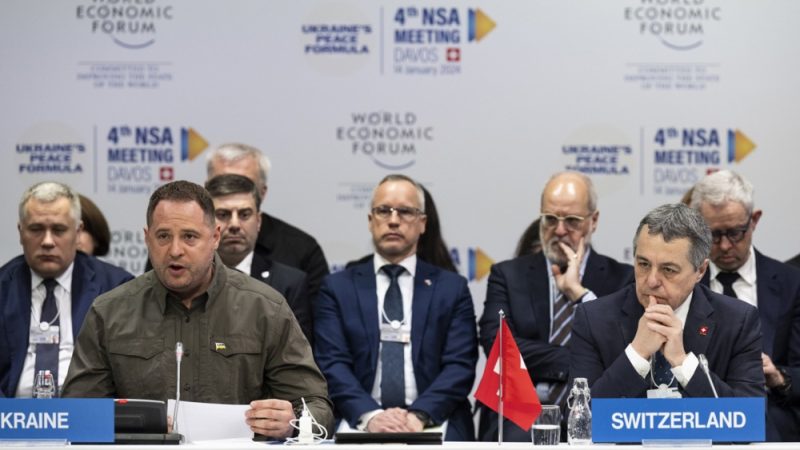
Security officials from 82 countries, including many non-Western nations, joined the fourth round of Ukraine-initiated talks to promote Kyiv’s peace proposals in Davos, Switzerland, on Sunday (15 January).
The meeting of national security advisors took place days before the World Economic Forum’s annual meeting, set to kick off on Tuesday (16 January), with Ukraine’s President Volodymyr Zelenskyy in attendance.
Ukrainian and Western officials hailed the increasing in-person participation of national security representatives from non-Western countries, including 18 from Asia and 12 from Africa.
The number of delegations attending the gathering was significantly more than the 65 that participated in the last round of talks in Malta last October and previously in Copenhagen and Jeddah.
Zelenskyy’s plan includes calls for the restoration of Ukraine’s territorial integrity, the withdrawal of Russian troops, protection of food and energy supplies, nuclear safety and the release of all prisoners.
But so far, the previous meetings have ended without a final declaration or a set leaders’ summit date.
In Davos, after finalising the discussions on all ten points, Ukraine proposed to hold the peace summit at the leaders’ level in the near future, drawing on the preparatory work over the last year.
Andriy Yermak, Zelenskyy’s chief of staff, told reporters that “open and very constructive talks” had been held between “countries who want to be on the side (. . .) of peace.”
Global South participants included national security advisors from Brazil and South Africa, who “were particularly active in the discussions”.
Ukrainian officials said other notable in-person participants included Argentina, Uruguay, Ecuador, Mexico, Israel, Nigeria and the Gulf countries.
But the decision by China, Moscow’s most important ally, to again not attend undermined its importance, Western officials said.
“The participation of the BRICS alliance is very important because these countries have a relationship with Russia,” said Swiss Foreign Minister Ignazio Cassis, who co-hosted the talks.
“China plays a significant role. We must find ways to work with China on this,” Cassis added in remarks to reporters during the talks.
While discussions involved “open dialogue, with some of the contradictions being addressed head on”, one person briefed on the talks said.
Several non-Western countries also reiterated their position that Russia should be involved and that a settlement should address Moscow’s security concerns, such as Ukraine’s desire to join NATO, they said.
Western partners “expressed unequivocal support to Ukraine and its peace plans, with a call on the Global South to make clear to Russia the importance of respecting the UN charter and its core principles in the interest of global security,” they added.
“Of course, we have different thoughts on how it is possible to [achieve peace],” Yermak said when asked about the cohesion of the talks.
“Some think it is necessary to immediately sit at the table [with Russia],” he said.
The peace formula talks do not involve Russia, which launched its full-scale invasion of Ukraine in February 2022 and has occupied nearly a fifth of the country.
To date, Moscow has rejected the initiative, saying it would be impossible to implement.
Ukrainian officials are also not interested in negotiations that could force them to cede territory to Russia, even as Western financial and military aid to Ukraine faces growing obstacles.
But neither Ukraine nor most Western officials believe the Kremlin has shown serious interest in a diplomatic outcome, with the latter insisting they will not pressure Kyiv into ceasefire talks.
But all delegations were “very united on the main principles on which is based international law and the statute of the United Nations,” Yermak added.
Yermak also stressed that no Western allies to date had ever asked Ukraine to make any compromise regarding its territory, “which they know is not acceptable for us,” and it would never accept a “frozen conflict.”
“For all Ukrainians, the most important (thing) is to win this war,” Yermak said.
Earlier in a statement from the Ukrainian presidency, Yermak said a simple cease-fire would not end Russia’s “aggression” on Ukraine: “It’s definitely not the path to peace. The Russians do not want peace. They want domination.”
[Edited by Alice Taylor]