Physical Address
Indirizzo: Via Mario Greco 60, Buttigliera Alta, 10090, Torino, Italy
Physical Address
Indirizzo: Via Mario Greco 60, Buttigliera Alta, 10090, Torino, Italy

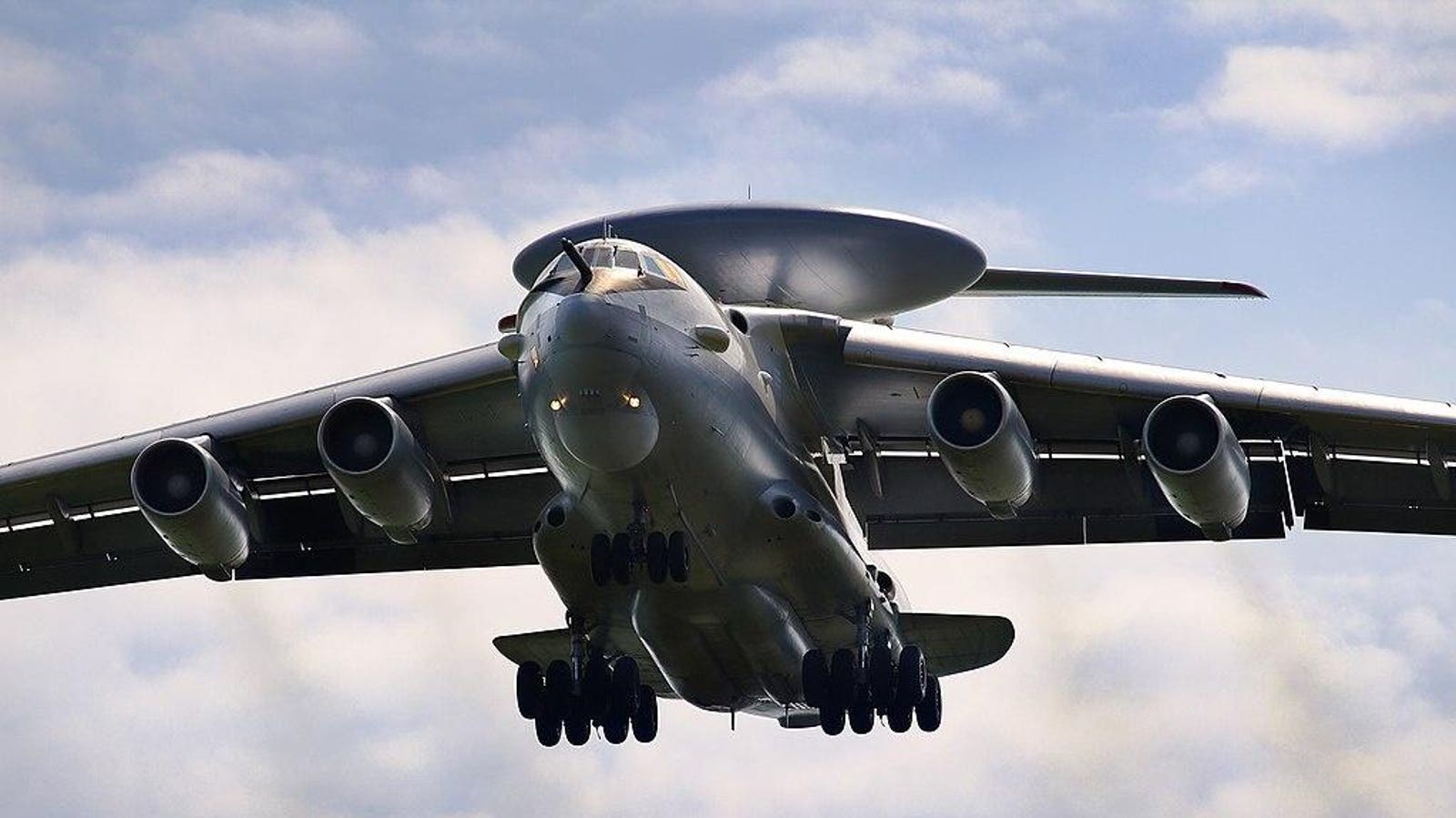
A Beriev A-50.
Wikimedia Commons
When, on Jan. 14, Ukrainian air-defenses shot down one of the Russian air force’s rare Beriev A-50 radar early-warning planes—and damaged an accompanying Ilyushin Il-22M relay plane—it surprised many observers.
Not because the Ukrainians aren’t adept air-defenders with reasonably modern equipment including American-made Patriot PAC-2 surface-to-air missile batteries. Every few weeks, the Ukrainian air force stages a complex missile ambush and shoots down entire flights of Russian warplanes.
No, what was weird was that the Russians flew the four-engine A-50U/M—one of just eight or so in service, of which just two or three are fully combat-capable—close enough to the front line to expose it to Ukrainian missiles. The A-50 reportedly was just shy of 100 miles from the front line in southern Ukraine when it got hit and crashed into the sea of Azov, killing all 15 or so people aboard.
At that distance, two of Ukraine’s air-defense systems—its Patriots and its Soviet-vintage S-200s—could reach the A-50. What’s weird is that the A-50 with its top-mounted Vega radar should be capable of detecting aircraft from 250 miles away.
But the detection range decreases as the target’s size decreases. And that, according to an assessment by U.S. Army air-defense officer Maj. Peter Mitchell, might explain why the A-50 was so close to the front on Jan. 14.
“The Russians likely felt that putting their valuable [early-warning] aircraft at risk was necessary,” Mitchell wrote for West Point’s Modern War Institute. “The A-50 over the Sea of Azov … would not have dared come so close to the front unless the need for a complete radar picture running the full length of the front line was extremely pressing.”
The imminent arrival of Ukraine’s ex-European Lockheed Martin
LMT
The risk was real. The A-50 got shot down. The F-16s haven’t even arrived yet. And now the Russians must regroup. The missile ambush that destroyed the A-50 “will likely have the effect of forcing the Russians to move their [early-warning planes] orbits farther east,” Mitchell wrote.
This isn’t conjecture. There’s evidence the Russian air force now is flying its southern A-50 sorties over the Russian city of Krasnador, 275 miles from the front line.
But at this range, the A-50 might struggle to detect small targets such as F-16s if the F-16s don’t stray too far from the front. “This in turn will increase detection time and the cushion that Ukrainian aircraft have to perform their mission—and escape before being detected and intercepted themselves,” Mitchell pointed out.
This buffer is “a crucial advantage on the modern battlefield where, so often, to be seen is to be dead.”
All that is to say, it’s possible—though difficult to confirm—that the Russians edged the A-50 closer to the front in order to set a trap for the Ukrainians’ new F-16s. But instead, it was the A-50 that fell into a trap.